Friday, October 27, 2006

goodbye maya.


1.26.1976 - 10.26.2006

i miss you so much already.

Saturday, October 7, 2006

New Government in Sweden

Well, things do happen in life, as we know.

On Friday I was appointed Foreign Minister of Sweden in a move that was widely seen as somewhat surprising.

And in many ways it was. But when asked, while it wasn't entirely easy to say yes, it would have been impossible to say no.

So that's the way it is. And there is a very good team at the ministry with Gunilla Carlsson doing international development issues and Maria Borelius doing international trade. In addition, there is Cecilia Malmström as Minister for European Affairs located in the Prime Minister's Office.

All together a rather strong team.

And the policy declaration of the new government is also very clear on the priorities also in foreign affairs.

We clearly want to be in the centre of the process of European integration. We want a Europe that is a strong voice for freedom, democracy, peace and reconciliation throughout the world. We are convinced of the need to go on with the process of enlargement of the European Union. We seek security in the cooperation with other nations. We value the transatlantic link. We remain a strong supported of the United Nations.

All in all a modern foreign policy.

So that's what I'm doing at the moment. These days to a large extent getting the house in order. But then onwards...

Thursday, October 5, 2006

Speaking in New York City on October 10th

I'll be giving a talk for the Linnaean Society of New York at 7:30 pm on October 10th at the American Museum of Natural History. Admission is free. Please enter at West 77th street between Central Park West and Columbus Avenue. The talk will be held in the Lindner Theater.

I'm looking forward to sharing some good things happening in Iraq. In the talks I've done before, I always meet some great like-minded people.

Wednesday, October 4, 2006

Call For Mid East Action

Today is published a major appeal for a new push towards peace in the Middle East, signed by a large number of public leaders around the world.

And I am among those that have signed the appeal.

It comes at the same time as US Secretary of State Rice is touring the region and exploring the possibilities of moving forward.

And it comes when there is a mounting interest in Europe in taking some sort of initiative. The present policy vacuum on the key issues of the conflict are nothing less than dangereous.

Another appeal in another critical situation.

Will it have any effect?

Tuesday, October 3, 2006

Clean Coal or Dirty Coal?

When President Bush said “America is addicted to oil”, he could also have said that America is addicted to coal.

Most Americans are not aware of the sheer scale of current coal use in the United States. Over 50% of electricity is generated from coal with 20 pounds of coal per a person being burnt every day to generate electricity.

While questions are increasingly being raised about remaining oil and gas reserves, we are assured that there is plenty of coal left to burn. Indeed in a talk to a meeting of builders and contractors at the Capital Hilton on June 8, 2005 President Bush asked the audience,
"Do you realize we've got 250 million years of coal?"

Hopefully readers will spot this obvious gaffe. The figure quoted by the coal industry is 250 years of reserves, not 250 million years. The energy illiteracy of the average person is worrying enough, but in our political leadership it is a real cause for concern.

There are an estimated one trillion tons of recoverable coal in the world, by far the largest reserve of fossil fuel left on the planet. The United States has over 25% of the world’s recoverable coal reserves. An important point to remember when considering how many years of coal we have left is that these figures are based on current rates of consumption and do no take into account growing demand for electricity. Since 1980 coal use for power generation has increased by over 75%.

A good percentage of the coal that’s left is too dirty to be burned in conventional power plants and much of its buried in inconvenient places. In 1974 the USGS published an estimate of the recoverable reserve base at 243 billion tons. This however failed to take into account real world restrictions on mining: state and national parks, roads, towns, proximity to railroads, coal quality, losses during mining and geologic limitations. When these are factored in less than 50% of the coal estimated as “recoverable” in the 1974 study was available for mining. This fails to taken into account how much is economically recoverable at market prices. In a 1989 study by the U.S. Bureau of Mines in Kentucky, at $30 a ton 22% of coal was economically recoverable. The author Tim Rohrbacher wrote “a strong argument can be made that traditional coal producing regions may soon be experiencing resource depletion problems far greater and much sooner than previously thought”.

Recently there has been a rise in suggestions that America should replace its addiction to oil, with diesel fuel made from American coal. There is currently in place a Coal-to-Liquids Tax Credit of $0.50/gallon in place until 2023. The idea has been around for a long while, in the second world war it was used by the Germans to make Nazi oil from coal when their supply of normal gasoline was cut off. I remember when I first started researching peak oil I realised after awhile if things got bad that coal rich countries might turn to making Nazi oil in desperation when petroleum depletion started to bite. Of course calls to start building Coal to Liquids plants aren’t proof that petroleum depletion is well advanced, but I hardly see it as a source for optimism.


Fischer-Tropsch pilot plant

You don’t need to be an expert on coal liquefaction to realise that it’s a bad idea as this article on AutoblogGreen shows. It’s expensive, uses lots of water, produces double the carbon dioxide when compared to regular petroleum use and produces diesel when the vast majority of the U.S. car fleet runs on gasoline. Over at the Ergosphere, the Engineer Poet crunches the numbers and compares coal to liquids versus electric vehicles. He calculates that to replace the United States petroleum consumption at current rates would take 214 four billion dollar coal to liquid plants (that’s not far off a trillion dollars in investment) and the mining of an additional one and a half billion tons of coal a year, in addition to the one billion tons already being mined for electricity generation. It should be noted that the high percentage of electricity currently produced from coal is not an argument against electric vehicles, this is something I have covered in detail elsewhere on this blog. Electric motors are inherently more efficient than the internal combustion engine. It is far easier to control emissions from large power plant, than from the exhausts of thousands of cars. Electric vehicles are not reliant on one source of energy and in the longer term polluting non-renewable sources of electricity can be replaced by clean alternative energy.

The coal industry’s promotion of the idea that America has a vast reserve of coal is slowing the transition to clean renewable sources of energy. In addition to tv spots showing child actors extolling the virtues of coal, the industry has spent heavily to get the ear of the political establishment. According to the Center for Responsive Politics, Peabody Energy, the world’s largest coal company spent over 5% of its revenues on political contributions, for comparison Exxon Mobil and General Motors spent a fraction of one percent.

In seeming return for such generosity, The Energy Policy Act of 2005 included five billion dollars of subsidies for the coal industry.

Virtually every power plant built in America between 1975 and 2002 was fired by natural gas. However between 1970 and 2000, the amount of coal America used to generate electricity tripled.

Now with natural gas prices rising steeply, U.S. power utilities are expected to build the equivalent of 280 500 megawatt coal-fired electricity power plants between 2003 and 2030. China is already constructing the equivalent of one large coal burning power plant a week with two thirds of energy production coming from dirty coal. 16 of the 20 most polluted cities in the world are in China. India is the third largest producer of coal in the world, also getting over two thirds of its energy from coal. If these new coal plants are built, they will add as much carbon dioxide to the atmosphere as has been released by all the coal burned in the last 250 years.


Acid run off from coal mining

Coal’s sale price may be low, but the true costs of its extraction, processing and consumption are high. Our use of coal leads to ravaged mountains, air pollution from acidic and toxic emissions and fouled water supplies. Coal mining is massively more invasive than oil or gas drilling. Coal burning power plants account for more than two-thirds of sulfur dioxide, 22% of nitrogen oxides, nearly 40% of carbon dioxide and a third of all mercury emissions in the United States. Results of the largest mercury hair sampling project in the U.S. found mercury levels exceeding the EPA’s recommended limit of one microgram of mercury per gram of hair in one in five women of childbearing age tested. Each year coal plants produce about 130 million tons of solid waste, about three times more than all the municipal garbage in the U.S. The American Lung Association calculates that around 24,000 people a year die prematurely from the effects of coal fired power plant pollution.

Techniques for addressing CO2 emissions exist, although the will to quickly implement them lags.

The techniques electric utilities could apply to keep much of the carbon dioxide they produce from entering the atmosphere are known as CO2 capture or geological carbon sequestration. This involves separating the CO2 as it is created and pumping it underground to be stored.

Until recently I wasn’t aware that all the technological components needed for carbon sequestration are commercially ready (according to an article in September’s Scientific American magazine) as they have already been proven in applications unrelated to avoidance of climate change. However integrated systems have yet to be built on a commercial scale.

Capture technologies have been deployed extensively throughout the world both in the manufacture of chemicals (e.g. fertilizer) and in the purification of natural gas. Industry has gained experience with CO2 storage in operations to purify natural gas, principally in Canada, as well as using carbon dioxide to boost oil production, mainly in the United States.


The Intergovernmental Panel on Climate Change (IPCC) estimated in 2005 that it is highly likely that geologic locations worldwide are capable of sequestering at least two trillion metric tons of CO2 - more than is likely to be produced by fossil fuel consuming power plants this century.

Carbon sequestration is not without risk. The two main risks are sudden escape and gradual leakage of carbon dioxide. In 1986 at Lake Nyos in Cameroon, Africa carbon dioxide originating from a volcano killed over 1,700 people. However according to IPCC this is unlikely for engineered CO2 storage in carefully selected, deep porous geologic rock formations. In regard to gradual leakage the IPCC estimated in 2005 that in excess of 99% of carbon sequestered is “very likely” to remain in place for at least one hundred years.

Studies indicate that 85%-95% of the carbon in coal could be sequestered using existing power generation technologies.


A key point is that fundamentally different approaches to carbon capture would need to be pursued for power plants using the old pulverised coal technology as opposed to the newer integrated gasification combined cycle (IGCC). IGCC plants use heat and pressure to cook off impurities in coal and convert it into a synthetic gas, this gas is then burnt in a turbine. These plants are 10% more efficient than conventional plants, consume 40% less water, produce 50% less solid waste and burn almost as cleanly as natural gas plants.

Although building IGCC power plants is slightly more expensive (10%-20%), IGCC is likely to be the most effective and cheapest option for carbon capture.

In an IGCC plant designed to capture CO2 the syngas exiting the gasifier, after being cooled and cleaned of particles, would be reacted with steam to make a gas made up mainly of CO2 and hydrogen. The CO2 would then be extracted and pumped to a storage site. The remaining hydrogen would be burned to generate more power. Captured carbon dioxide can by piped up to several hundred miles to a suitable geologic storage site.

A recent study found that for carbon capture in a saline formation one hundred kilometers from a power plant would cost an additional 1.9 cents per kilowatt-hour (over the generation cost of 4.7 cents per kilowatt-hour for a coal IGCC plant that vents carbon dioxide), making a 40% premium. With coal generation costing 6.6 cents for a kilowatt hour, this would make wind power cheaper than coal and with technology advances could also provide a boost to other renewable energy sources (e.g. concentrating solar power).

However electricity producers are rushing to build conventional coal pulverisation power plants, just as they rushed to build coal plants without sulfur scrubbers prior to legislation coming into force. This is short-sighted as it is more expensive, more energy intensive and less effective to attempt to capture carbon from conventional coal power plants. It is highly likely that having built these plants, that the coal industry would expect the taxpayer to foot the bill for the additional expense. Of the one hundred or so plants being planned or under construction in America only a handful use IGCC technology.


Proposed Design for FutureGen

FutureGen, is the Department of Energy financed one billion dollar zero emissions plant intended to turn coal into electricity and hydrogen. Proposed in 2003 and backed by a consortium of coal and electric companies, it is not due to come online until at least 2013. Many in the industry consider this date to be dubious nicknaming the project NeverGen. It is intended to make it look like the coal industry is doing something, while actually doing very little and in the process putting off changing how coal plants are built for a decade or two. Indeed in its Coal Vision report(pdf), the industry does not plan on building “ultra-low emissions” plants on a commerical scale until between 2025 and 2035. According to the report “there is considerable debate about the need to reduce CO2 emissions”. The report also states that “achieving meaningful CO2 reductions would require significant technical advances”.

The report further states “large scale and long term demonstrations of carbon sequestration technologies over a geographically and geologically diverse range of... sites are needed before making any policy decisions concerning carbon management”. The coal industry wants sequestration to be demonstrated not only in the United States but additionally “similar assessments need to be conducted internationally”. In terms of who should pay for these demonstrations the report writes “the government must play a significant role”.

It sounds that if the coal industry has its way, it won’t be using carbon capture for many decades.

Instead of waiting until 2013 or even 2035, the coal industry could be building IGCC power plants with carbon capture now. The rush to build conventional coal pulverisation plants is extremely short sighted as these plants could be operating for the next fifty years or more.

In the first instance I advocate maximising our use of clean renewable energy. At the moment wind power is being used to generate only 0.5% of electricity in the United States. Using existing technology wind power could cost effecively generate a significant portion of many countries electricity supply. Significant sums of money should also be invested in making solar power and wave power more cost effective, as well as investments in energy long shots such as cellulosic ethanol and fusion power. If we are going to continue to use coal as global society as a major source of energy, which seems pretty much inevitable for at least the next few decades in key countries such as the United States, China & India, then we should be building IGCC power plants with carbon capture and retiring existing dirty coal plants now. If there are unforeseen problems with carbon capture, we need to find out now rather than in a few decades time. The coal industry's business as usual attitude is simply not acceptable.

Jeff Goodell in his recent book “Big Coal” concludes, “coal gives us a false sense of security, if we run out of gas and oil, we can just switch over to coal… the most dangerous things about our continued dependence on coal is it preserves the illusion that we don’t have to change our thinking”.

Further Reading:
Big Coal” by Jeff Goodell
“What to Do About Coal?” in Scientific American September, 2006

Lively Discussion of Coal to Liquids

Coal Vision by the Coal Based Generation Stakeholders Group

Mountaintop Removal

A Quick Guide to Mountaintop Removal Coal Mining

When Will Coal Production Peak?

Clean Coal or Dirty Coal?

When President Bush said “America is addicted to oil”, he could also have said that America is addicted to coal.

Most Americans are not aware of the sheer scale of current coal use in the United States. Over 50% of electricity is generated from coal with 20 pounds of coal per a person being burnt every day to generate electricity.

While questions are increasingly being raised about remaining oil and gas reserves, we are assured that there is plenty of coal left to burn. Indeed in a talk to a meeting of builders and contractors at the Capital Hilton on June 8, 2005 President Bush asked the audience,
"Do you realize we've got 250 million years of coal?"

Hopefully readers will spot this obvious gaffe. The figure quoted by the coal industry is 250 years of reserves, not 250 million years. The energy illiteracy of the average person is worrying enough, but in our political leadership it is a real cause for concern.

There are an estimated one trillion tons of recoverable coal in the world, by far the largest reserve of fossil fuel left on the planet. The United States has over 25% of the world’s recoverable coal reserves. An important point to remember when considering how many years of coal we have left is that these figures are based on current rates of consumption and do no take into account growing demand for electricity. Since 1980 coal use for power generation has increased by over 75%.

A good percentage of the coal that’s left is too dirty to be burned in conventional power plants and much of its buried in inconvenient places. In 1974 the USGS published an estimate of the recoverable reserve base at 243 billion tons. This however failed to take into account real world restrictions on mining: state and national parks, roads, towns, proximity to railroads, coal quality, losses during mining and geologic limitations. When these are factored in less than 50% of the coal estimated as “recoverable” in the 1974 study was available for mining. This fails to taken into account how much is economically recoverable at market prices. In a 1989 study by the U.S. Bureau of Mines in Kentucky, at $30 a ton 22% of coal was economically recoverable. The author Tim Rohrbacher wrote “a strong argument can be made that traditional coal producing regions may soon be experiencing resource depletion problems far greater and much sooner than previously thought”.

Recently there has been a rise in suggestions that America should replace its addiction to oil, with diesel fuel made from American coal. There is currently in place a Coal-to-Liquids Tax Credit of $0.50/gallon in place until 2023. The idea has been around for a long while, in the second world war it was used by the Germans to make Nazi oil from coal when their supply of normal gasoline was cut off. I remember when I first started researching peak oil I realised after awhile if things got bad that coal rich countries might turn to making Nazi oil in desperation when petroleum depletion started to bite. Of course calls to start building Coal to Liquids plants aren’t proof that petroleum depletion is well advanced, but I hardly see it as a source for optimism.


Fischer-Tropsch pilot plant

You don’t need to be an expert on coal liquefaction to realise that it’s a bad idea as this article on AutoblogGreen shows. It’s expensive, uses lots of water, produces double the carbon dioxide when compared to regular petroleum use and produces diesel when the vast majority of the U.S. car fleet runs on gasoline. Over at the Ergosphere, the Engineer Poet crunches the numbers and compares coal to liquids versus electric vehicles. He calculates that to replace the United States petroleum consumption at current rates would take 214 four billion dollar coal to liquid plants (that’s not far off a trillion dollars in investment) and the mining of an additional one and a half billion tons of coal a year, in addition to the one billion tons already being mined for electricity generation. It should be noted that the high percentage of electricity currently produced from coal is not an argument against electric vehicles, this is something I have covered in detail elsewhere on this blog. Electric motors are inherently more efficient than the internal combustion engine. It is far easier to control emissions from large power plant, than from the exhausts of thousands of cars. Electric vehicles are not reliant on one source of energy and in the longer term polluting non-renewable sources of electricity can be replaced by clean alternative energy.

The coal industry’s promotion of the idea that America has a vast reserve of coal is slowing the transition to clean renewable sources of energy. In addition to tv spots showing child actors extolling the virtues of coal, the industry has spent heavily to get the ear of the political establishment. According to the Center for Responsive Politics, Peabody Energy, the world’s largest coal company spent over 5% of its revenues on political contributions, for comparison Exxon Mobil and General Motors spent a fraction of one percent.

In seeming return for such generosity, The Energy Policy Act of 2005 included five billion dollars of subsidies for the coal industry.

Virtually every power plant built in America between 1975 and 2002 was fired by natural gas. However between 1970 and 2000, the amount of coal America used to generate electricity tripled.

Now with natural gas prices rising steeply, U.S. power utilities are expected to build the equivalent of 280 500 megawatt coal-fired electricity power plants between 2003 and 2030. China is already constructing the equivalent of one large coal burning power plant a week with two thirds of energy production coming from dirty coal. 16 of the 20 most polluted cities in the world are in China. India is the third largest producer of coal in the world, also getting over two thirds of its energy from coal. If these new coal plants are built, they will add as much carbon dioxide to the atmosphere as has been released by all the coal burned in the last 250 years.


Acid run off from coal mining

Coal’s sale price may be low, but the true costs of its extraction, processing and consumption are high. Our use of coal leads to ravaged mountains, air pollution from acidic and toxic emissions and fouled water supplies. Coal mining is massively more invasive than oil or gas drilling. Coal burning power plants account for more than two-thirds of sulfur dioxide, 22% of nitrogen oxides, nearly 40% of carbon dioxide and a third of all mercury emissions in the United States. Results of the largest mercury hair sampling project in the U.S. found mercury levels exceeding the EPA’s recommended limit of one microgram of mercury per gram of hair in one in five women of childbearing age tested. Each year coal plants produce about 130 million tons of solid waste, about three times more than all the municipal garbage in the U.S. The American Lung Association calculates that around 24,000 people a year die prematurely from the effects of coal fired power plant pollution.

Techniques for addressing CO2 emissions exist, although the will to quickly implement them lags.

The techniques electric utilities could apply to keep much of the carbon dioxide they produce from entering the atmosphere are known as CO2 capture or geological carbon sequestration. This involves separating the CO2 as it is created and pumping it underground to be stored.

Until recently I wasn’t aware that all the technological components needed for carbon sequestration are commercially ready (according to an article in September’s Scientific American magazine) as they have already been proven in applications unrelated to avoidance of climate change. However integrated systems have yet to be built on a commercial scale.

Capture technologies have been deployed extensively throughout the world both in the manufacture of chemicals (e.g. fertilizer) and in the purification of natural gas. Industry has gained experience with CO2 storage in operations to purify natural gas, principally in Canada, as well as using carbon dioxide to boost oil production, mainly in the United States.


The Intergovernmental Panel on Climate Change (IPCC) estimated in 2005 that it is highly likely that geologic locations worldwide are capable of sequestering at least two trillion metric tons of CO2 - more than is likely to be produced by fossil fuel consuming power plants this century.

Carbon sequestration is not without risk. The two main risks are sudden escape and gradual leakage of carbon dioxide. In 1986 at Lake Nyos in Cameroon, Africa carbon dioxide originating from a volcano killed over 1,700 people. However according to IPCC this is unlikely for engineered CO2 storage in carefully selected, deep porous geologic rock formations. In regard to gradual leakage the IPCC estimated in 2005 that in excess of 99% of carbon sequestered is “very likely” to remain in place for at least one hundred years.

Studies indicate that 85%-95% of the carbon in coal could be sequestered using existing power generation technologies.


A key point is that fundamentally different approaches to carbon capture would need to be pursued for power plants using the old pulverised coal technology as opposed to the newer integrated gasification combined cycle (IGCC). IGCC plants use heat and pressure to cook off impurities in coal and convert it into a synthetic gas, this gas is then burnt in a turbine. These plants are 10% more efficient than conventional plants, consume 40% less water, produce 50% less solid waste and burn almost as cleanly as natural gas plants.

Although building IGCC power plants is slightly more expensive (10%-20%), IGCC is likely to be the most effective and cheapest option for carbon capture.

In an IGCC plant designed to capture CO2 the syngas exiting the gasifier, after being cooled and cleaned of particles, would be reacted with steam to make a gas made up mainly of CO2 and hydrogen. The CO2 would then be extracted and pumped to a storage site. The remaining hydrogen would be burned to generate more power. Captured carbon dioxide can by piped up to several hundred miles to a suitable geologic storage site.

A recent study found that for carbon capture in a saline formation one hundred kilometers from a power plant would cost an additional 1.9 cents per kilowatt-hour (over the generation cost of 4.7 cents per kilowatt-hour for a coal IGCC plant that vents carbon dioxide), making a 40% premium. With coal generation costing 6.6 cents for a kilowatt hour, this would make wind power cheaper than coal and with technology advances could also provide a boost to other renewable energy sources (e.g. concentrating solar power).

However electricity producers are rushing to build conventional coal pulverisation power plants, just as they rushed to build coal plants without sulfur scrubbers prior to legislation coming into force. This is short-sighted as it is more expensive, more energy intensive and less effective to attempt to capture carbon from conventional coal power plants. It is highly likely that having built these plants, that the coal industry would expect the taxpayer to foot the bill for the additional expense. Of the one hundred or so plants being planned or under construction in America only a handful use IGCC technology.


Proposed Design for FutureGen

FutureGen, is the Department of Energy financed one billion dollar zero emissions plant intended to turn coal into electricity and hydrogen. Proposed in 2003 and backed by a consortium of coal and electric companies, it is not due to come online until at least 2013. Many in the industry consider this date to be dubious nicknaming the project NeverGen. It is intended to make it look like the coal industry is doing something, while actually doing very little and in the process putting off changing how coal plants are built for a decade or two. Indeed in its Coal Vision report(pdf), the industry does not plan on building “ultra-low emissions” plants on a commerical scale until between 2025 and 2035. According to the report “there is considerable debate about the need to reduce CO2 emissions”. The report also states that “achieving meaningful CO2 reductions would require significant technical advances”.

The report further states “large scale and long term demonstrations of carbon sequestration technologies over a geographically and geologically diverse range of... sites are needed before making any policy decisions concerning carbon management”. The coal industry wants sequestration to be demonstrated not only in the United States but additionally “similar assessments need to be conducted internationally”. In terms of who should pay for these demonstrations the report writes “the government must play a significant role”.

It sounds that if the coal industry has its way, it won’t be using carbon capture for many decades.

Instead of waiting until 2013 or even 2035, the coal industry could be building IGCC power plants with carbon capture now. The rush to build conventional coal pulverisation plants is extremely short sighted as these plants could be operating for the next fifty years or more.

In the first instance I advocate maximising our use of clean renewable energy. At the moment wind power is being used to generate only 0.5% of electricity in the United States. Using existing technology wind power could cost effecively generate a significant portion of many countries electricity supply. Significant sums of money should also be invested in making solar power and wave power more cost effective, as well as investments in energy long shots such as cellulosic ethanol and fusion power. If we are going to continue to use coal as global society as a major source of energy, which seems pretty much inevitable for at least the next few decades in key countries such as the United States, China & India, then we should be building IGCC power plants with carbon capture and retiring existing dirty coal plants now. If there are unforeseen problems with carbon capture, we need to find out now rather than in a few decades time. The coal industry's business as usual attitude is simply not acceptable.

Jeff Goodell in his recent book “Big Coal” concludes, “coal gives us a false sense of security, if we run out of gas and oil, we can just switch over to coal… the most dangerous things about our continued dependence on coal is it preserves the illusion that we don’t have to change our thinking”.

Further Reading:
Big Coal” by Jeff Goodell
“What to Do About Coal?” in Scientific American September, 2006

Lively Discussion of Coal to Liquids

Coal Vision by the Coal Based Generation Stakeholders Group

Mountaintop Removal

A Quick Guide to Mountaintop Removal Coal Mining

When Will Coal Production Peak?

Keflavik Moves On

A couple of days ago, the last part of the US military base at Keflavik on Iceland was closed down.

It's a historic move showing the new times we are living in.

For close to a generation, Keflavik was the by far most important military installation in northern Europe. It was the linchpin of Atlantic and Northern security during the cold decades of the Cold War.

Operated primarily by the US Navy, the mission centered on the runways, command and control as well as intelligence facilities at and around Keflavik was to prevent any Soviet naval break-throughs towards the Atlantic supply lines connecting the United States and Western Europe, as well as facilitating Western movements up towards the northern parts of the Atlantic.

From here, important parts of the vast sub-surface and air patrol system that sought to track Soviet nuclear submarines as they exited their base areas up on the Kola peninsula or beyond and heading towards the Denmark Strait between Iceland and Greenland were run.

In addition, there were the aircrafts for the air defence of Iceland and the very large radar stations on northern and eastern parts of Iceland.

It was no coincidence that one of the books trying to look into how a possible Soviet surprise attack against the West would look started with a very cleverly executed raid against Keflavik. It was the key installation.

But no it's all gone. Left are empty hangars and large living quarters for the thousands of soldiers and families that were stationed there.

It's a new world.

Ban Ki Moon Takes Clear Lead

Yesterday's straw poll in the Security Council made it likely that Ban Ki Moon would in fact emerge as the next Secretary-General of the United Nations.

He was the only one of the contenders that did not receive one or more discouraging votes from permanent members of the Security Council, as well as receiving encouraging ones from 14 out of the 15 members.

And number two in the race - Shashi Tharoor from India- immediately gave a concession speech and pledged his support for Ban Ki Moon.

More important than this were statements by the ambassadors of both China and the United States. China's Permanent Representative said that it was "quite clear" that Mr Moon was the candidate, and John Bolton for the US said that he would be "surprised" if there were any new names that would enter the race.

So much for my previous guess that this would in fact happen!

The Security Council now moves towards a formal vote next Monday. That might decide the issue, with the nomination of the Council then going forward for confirmation to the General Assembly.

Latvia's Vike-Freiberga came in a most honourable number three in this last straw poll, although with two permanent members - Russia? China? - casting discouraging votes.

But all in all it was a most impressive achievement by her and by Latvia.

Now we will see what happens on Monday.

Monday, October 2, 2006

Bosnian Challenges

If I was wrong in my predictions for the Austrian elections, it looks as if I was somewhat less unsuccesful in the Bosnian case.

With preliminary results in, we see a significant shift among both the Bosnian Muslim and Bosnian Serb voters.

The old and traditional nationalist parties - SDA and SDS, respectively - have been outflanked and defeated by forces using more of nationalist rhetoric, although a general desire for change has in all probability also played a role.

The Bosnian Muslim seat in the Presidency will now be taken by Haris Silajdzic and the Bosnian Serb one by Nebojsa Radmanovic.

The former wants to abolish Republika Srpska, while the latter comes from a party that has recently started to toy with the idea of abolishing Bosnia. Eleven years after Dayton, that's not too encouraging a result.

But while things do look bad on paper I don't think there is any cause for alarm. And I would strongly caution against any thought of outside political intervention of the one sort or the other.

At the end of the day these gentlemen will have to find their own compromises if they want to live together. And with all of Europe - including, slowly and somewhat reluctantly even the Balkans - coming together they know that they haven't got much of a choice.

So Bosnia is to be congratulated to a well run and democratic election. That's good.

And then it is to be wished well in its attempts to live with the result.

That's democracy. Sometimes a messy thing - but always better than the alternatives.

The New Week

Another week of changes starting its journey.

On Friday we'll get the new government in Sweden. And there will obviously be a new government in Austria at some point in time.

We are still waiting for the election results from Bosnia to see what they might imply.

And that local elections in Hungary brought setbacks for the ruling Socialists was hardly surprising.

The week will also bring important local elections in Georgia - in the middle of its dangereous crisis with Russia.

My week will be somewhat more Stockholm than usual.

But on Wednesday and Thursday I'm off to Rome for meetings there with business and government representatives, including Prime Minister Prodi. It will be centered on the role and possibilities of Italy as globalisation accelerates.

And then I might head from there to Brussels for some informal talks on the question of Turkey's accession to the European Union. That's a subject that will also be in focus the coming days due to Chancellor Merkel's visit to Ankara in the weel.

Slowly, we see autumn arriving in Stockholm.

Sunday, October 1, 2006

Surprise in Austria

It is indeed somewhat of a surprise to everyone to see the SPÖ coming out on top of the Austrian elections today.
Everyone - including myself - had expected ÖVP and Chancellor Schuessel to come out on top, although probably not repeating the very good 2002 election result.

But the voters wanted otherwise. ÖVP lost more than 8 % and ended up with 66 seats in the Nationalrat, while SPÖ lost 0,8 % and ended up with 68 seats.

And that means that the SPÖ leader Gusenbauer is likely to be the one trying to form a coalition - which at the end of the days might well include ÖVP.

If you compare with the Swedish election two weeks ago, it's interesting to see the difference between the two countries.

While SPÖ completely dominated Vienna, with ÖVP only having marginally more than 20 % there, the Social Democrats in Sweden suffered their worst losses in the metropolitan Stockholm area, and are now a distinct minority party there, with the Moderates being the by far leading force among the uran middle classes.

In contrast. ÖVP retains its bastions in Tyrol, where the SPÖ is virtually nothing. This sounds rather like the Swedish Social Democrats who are scoring their best results in the less populated, rural and somewhat problematic parts of the country.

Two different countries.

Now let's see what kind of government Mr Gusenbauer will manage to get together.

It's Austria, and it will take some time.

Saturday, September 30, 2006

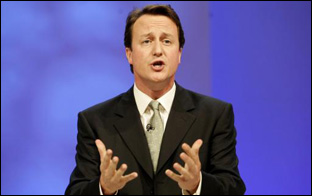
Liberal Conservatism

I promised to come back to David Cameron as well after my comments on - and praise for - Tony Blair.

On September 11 he delivered a speech on foreign affairs that has been much commented upon since.

That's primarily because his phrase that Britain should be "solid but not slavish" in its friendship with the United States. The swipe at Blair was difficult not to understand.

But there is far more to the speech than that.

In fact, he makes a rather interesting attempt to distinguish his so called liberal conservatism on international affairs from the so called neo-conservatism that has been doing much of the running in the Anglo-Sachson world in the last few years.

And its worth reading.

I particularly liked the way he looks at the struggle against terrorism around the world:

"Part of the problem we have encountered these past five years is that the struggle has been perceived - as the terrorists want it to be perceived - as a single struggle between single protagonists.

The danger is that by positing a single source of terrorism - a global jihad - and opposing it with a single global response - American-backed force - we will simply fulfil our own prophecy.

We are not engaged in a clash of civilisations, and suggestions that we are can too easily have the opposite effect to the one intended: making the extremists more attractive to the uncommitted

This is not to deny the connections between terrorist activity in different parts of the world.

It is simply an appeal for us to be a little smarter in how we handle those connections.

Our aim should be to dismantle the threat, separating its component parts, rather than amalgamating them into a single global jihad that simply becomes a call to arms.
"

I think this is entirely correct - and the difference between much of what is dominating on the other side of the Atlantic is profound.

It is by dismantling or disaggregating the situations, and then dealing with them one after the other, that we have the greatest possibilities of making progress.

Lumping them all together in one big battle to which we also give the description "war" probably serves Usama bin Laden better than it serves anything else.

The David Cameron restyling has certainly been about style to a very large extent.

But the speech on foreign policy showed interesting and important substance as well.

Green Green Green Blue

With the UK Conservatives getting together for their party conference in Bournemouth, there will be a lot of attention on the changes they are undergoing.

Is it just style? Where is really the substance?

As usual there is likely to be a bit of both in what's going on, and that's only natural.

When times are changing the challenges of politics are changing and so must the political parties.

Tony Blair spoke about how the issues have gone from being "essentially British" a decade or so ago to being "essentially global" today and tomorrow. Very true. And very important.

The Conservatives are also emphasizing the global, although trying to perform the interesting intellectual balancing act of doing so without mentioning or getting involved with European issues.

And they are emphasizing their new green and environmentally friendly image. The tree-huggers of Notting Hill.

Just look at the new symbol and log of the Conservative Party.

Not really Churchill. Not really Macmillan. Certainly not Thatcher.

But certainly modern.

Next Round UN Race

Well, I was not entirely correct in my previous entry on the race to select the next Secretary-General of the UN.

There was indeed an interesting straw poll among UNSC members on Thursday.

But it had been decided to have another one on Monday - and that will be the one with colour-coded votes so that there is a difference between permanent and non-permanent member states.

That's when the real drama will begin.

Thursday's straw poll was interesting in that Latvia's Vaira Vike-Freiberga - who entered the race only two weeks ago - come in at third place. She had seven votes encouraging her against six votes discouraging her.

Only two candidates - present front-runner Ban Ki Moon from South Korea and Sashi Tharoor from India - did better. All others had more discoraging than encouraging votes - de facto the end of them.

The performance of Vaira Vike-Freibergis is indeed impressive, and she should be truly congratulated. Her success benefits the image of her country and all three of the Baltic countries.

But it's on Monday it gets real.

Will Russia put a red vote to her since she's Latvian? Probable, I would say. She has done a lot to improve relations between Russia and Latvia, but it's doubtful whether that's enough.

And which red votes will there be against the others? China will take out of the race the candidates it does not want to see going to the final round.

It will be interesting to follow, and this website will give you the latest.

At the end of the day I stand by my guess that it's likely to end up with someone who's not on today list.

Thursday, September 28, 2006

Next UN Secretary General

This is the day for a critical straw poll among the members of the UN Security Council on who will be the next Secretary General.

And its the first of the straw polls that makes a difference between permanent and non-permanent members of the Council. One discouraging vote from one of the so called P5's de facto means a veto and exit from the race.

In previous straw polls, there has be no way of seeing the rather critical difference betweehn the two categories of members.

Today, New York Times has invited the six official candidates to briefly present their views on what they want to do.

It makes interesting reading. I know three of them fairly well - they are all highly qualified individuals.

So far there are six candidates, but my guess that at the end of the day at the least one of them will be out of the game.

And my guess is also that there is more than a fair chance that the final choice of the P5 - in effect, the decision is theirs - will not be a person on the list of today.

Essentially Global

Passing by London on my way back from New York was a good opportunity to get up to speed on the transformations underway on the British political scene.

The Labour party has just finished its conference in Manchester, and the Conservatives are only days from theirs in Bournemouth.

Tony Blair is leaving - although probably not until May of next year or so - and Labour is challenged by the new Conservative leader David Cameron.

His ratings might be fairly low on the British scene at the moment, but I persist in seeing him as one of the both best and most interesting major political leaders in terms of making speeches.

And his farewell in Manchester was certainly not exception to that rule. It's worth reading in its whole.

But here I'll just quote at some length what he said about how the challenges of politics have changed during the last decade. From being essentially national, they have now become essentially global:

The scale of the challenges now dwarf what we faced in 1997. They are different, deeper, bigger, hammered out on the anvil of forces, global in nature, sweeping the world.

In 1997 the challenges we faced were essentially British. Today they are essentially global.

The world today is a vast reservoir of potential opportunity. New jobs in environmental technology, the creative industries, financial services. Cheap goods and travel. The internet. Advances in science and technology.

In 10 years we will think nothing of school-leavers going off to university anywhere in the world.

But with these opportunities comes huge insecurity.

In 1997 we barely mentioned China. Not any more. Last year China and India produced more graduates than all of Europe put together.

10 years ago, energy wasn't on the agenda. The environment an also-ran.

10 years ago, if we talked pensions we meant pensioners.

Immigration hardly raised.

Terrorism meant the IRA.

Not any more.

We used to feel we could shut our front door on the problems and conflicts of the wider world. Not any more.

Not with globalisation. Not with climate change. Not with organised crime. Not when suicide bombers born and bred in Britain bring carnage to the streets of London . In the name of religion.

A speech by the Pope to an academic seminar in Bavaria leads to protests in Britain.

The question today is different to the one we faced in 1997.

It is how we reconcile openness to the rich possibilities of globalisation, with security in the face of its threats.

How to be open and secure.


I would hope that every major political leader in every European country would be ready to spell out the nature of the tasks ahead in the same way.

Wednesday, September 27, 2006

Gloomy Perspectives

Just preparing to leave New York and head back to Sweden after an intense day of discussions here.

At the SACC NY centennial, Richard Holbrooke and I had a public discussions on the different challenges we are facing in the years ahead.

I'm afraid it was a rather gloomy session.

While I spoke of most things between Kabul and Khartoum becoming increasingly problematic, Holbrooke said the same but used the expression between Beirut and Bombay. At the end of the day it means the same.

And we both failed to see the coherent either European or American policies to address this, not to speak about coherence in approach across the Atlantic. But we agreed that without that appearing, the situations are likely to get worse.

Meanwhile, President Bush in Washington is trying to get President Musharaf of Pakistan and President Kharazai of Afghanistan to improve their relationship and be more effective in countering what the New York Times today actually calls an "insurgency" in Afghanistan.

The seriousness of the situation is illustrated not only by the word "insurgency", but also by fear that it is getting "iraqized". Not good.

President Bush has also decided to release to the public important part of the National Intelligence Estimate (NIE) dealing with terrorism that's been subject of controversy in the last few days.

It's worth reading - without being particularly sensational. You can find it through the NYT article on the subject.

Better head back to Stockholm.

Sunday, September 3, 2006

Plug-In Hybrid Campaign


I encourage everyone to sign this online plug in hybrid campaign urging automakers to produce plug-in hybrid electric vehicles (PHEVs). The petition basically says, 'If you build it, we will buy it.' Plug-in hybrids and electric vehicles are key to energy independence and reducing pollution.

Over 40 percent of the generating capacity in the U.S. sits idle or operates at a reduced load overnight, when most PHEVs would be charged. That means tens of millions of plug-ins could be charged every night without the need to build additional electric generation capacity.

According to the California Electric Transportation Coalition that commissioned a study, if automakers begin producing Plug-Ins within the next few years, 2.5 million cars (eight percent of the cars on America's roads) could be Plug-Ins by the year 2020. That's the equivalent of taking as many as 5 million of today's vehicles off the road. Annually that's 11.5 million tons of CO2 which won't be emitted and 1.14 Billion gallons of gasoline would be saved each year. For those concerned about energy security it is definitely a step in the right direction. Less than 2% of U.S. electricity is generated from oil, so using electricity as a transportation fuel would greatly reduce dependence on imported petroleum.

Sign the Plug-In Hybrid Petition

Plug-In Hybrid Campaign


I encourage everyone to sign this online plug in hybrid campaign urging automakers to produce plug-in hybrid electric vehicles (PHEVs). The petition basically says, 'If you build it, we will buy it.' Plug-in hybrids and electric vehicles are key to energy independence and reducing pollution.

Over 40 percent of the generating capacity in the U.S. sits idle or operates at a reduced load overnight, when most PHEVs would be charged. That means tens of millions of plug-ins could be charged every night without the need to build additional electric generation capacity.

According to the California Electric Transportation Coalition that commissioned a study, if automakers begin producing Plug-Ins within the next few years, 2.5 million cars (eight percent of the cars on America's roads) could be Plug-Ins by the year 2020. That's the equivalent of taking as many as 5 million of today's vehicles off the road. Annually that's 11.5 million tons of CO2 which won't be emitted and 1.14 Billion gallons of gasoline would be saved each year. For those concerned about energy security it is definitely a step in the right direction. Less than 2% of U.S. electricity is generated from oil, so using electricity as a transportation fuel would greatly reduce dependence on imported petroleum.

Sign the Plug-In Hybrid Petition

Tuesday, August 22, 2006

i'm alive.

ceasefire does not happen overnight.

it's not like you wake up one morning and the birds are singing and the sun is shining and you go to work like nothing ever happened.


week of hell.
this past week has been slow and tough. it is almost as if last month was all played in fast forward and then since the ceasefire, we are moving in ultra slow motion. for the last month, i just wanted everything to end... now, i don't know where to begin. for the last month, i would purposefully try and numb myself because i was too afraid to feel everything... today i am begging for my feelings to return because without them, i can not live.

after a month of stress and living in fear, everything has caught up with me...my throat hurts a lot and my stomach is in a perpetual mess. the knots have not gone yet and its beginning to cause physical damage. i am down, down, down. i couldn't lift a finger to type. i couldn't answer my phone calls. it was so difficult to wake up in the morning... (and i'm usually mrs. super positive!)

i guess it has all hit us one way or another- things are never going to be the same again. we can not live the lives we had a few months ago.

we have to live better. somehow... if that makes any sense.

i have been having the worst of nightmares... i don't know why i'm getting them now. before, i would give anything for a good nights rest. for a quiet night... now that i am sleeping, finally, i have allowed myself to return to the dreamworld... but, it's not a very nice place at the moment. it is full of fears and worries... and so many dead people.

i don't know if i could handle war again. i don't know how it is that i am still alive... i don't know if i could do it all over again. please, i don't want to.


the aftermath.
there were mass burials held this past week. so many bodies had been left to rot because no one could access them before. now they are being buried.

families are wondering why...? why....?

many people are getting sick. there is a new virus going around. i heard it has something to do with the toxins coming out of the damaged buildings plus the dead bodies... it could be from the oil spill.. from the tanks that burned for three weeks covering Beirut in a black smog... the virus lasts for a few days... its effects are vomiting, diarrhea and very high temperature.

on the day of the ceasefire, many people began the return to their homes. they crossed the rivers by foot when needed....they were so determined to get home.. to see if they still had a home. Nasrallah announced that he was going to fix all the houses for free... and that he would provide money to pay for accommodations for people who had lost their homes, while he fixed their old homes.

there are cluster bombs everywhere. they dropped cluster bombs on us... there are so many that didn't explode... they are so so dangerous.

in dahiye the other day, people put up banners on top of the rubble of the buildings. the banner read: made in USA.


the oil spill.
we have spent this last week trying to clean up our beaches. we were shovelling poluted sand and setting up absorbant "boomers" to capture the oil that is still spilling in from the water onto the beach. it has been physically demanding work. we went down wearing masks, gloves and protective clothing under the summer heat... shoveling sand off the beach and putting it into a big pile that would be later moved/contained. the ministry of environment has been slow to act. so, we, the civilians, as always, are taking care of our beautiful country.

the oil has been in our waters and on our beach for 5 weeks now. it is the worst environmental disaster Lebanon has ever seen. in most oil spills, the spill is cleaned up within 72 hours. it has been 5 weeks in Lebanon and we have yet to see a proper clean up process. a lot of the oil is now so deep into the sand and rocks, it will take years and years to clean up. a lot of the oil sunk and has now settled on the sea bed.. this is almost impossible to clean. a lot of the oil in the water has now broken into small globs... like a mirror that has been smashed into shards... making it also almost impossible to clean.

i wonder... why. why did the Israelies target a power plant? there were no Hizuballah fighters hiding there. it was no where near Hizuballah territory. this power plant is located only 30km south of Beirut in an area called Jiye. Jiye is where all our great beach spots are. Jiye is a touristic spot. Jiye is where all the girls flaunt their new g string bikinis and all the boys flex their hard earned muscles. Jiye is where we take Tapi to on Sundays to play with her ball on the beach. Jiye is where we somehow run into the same people we were hanging out with the night before. Jiye is where we somehow continue the conversations from the night before over an ice cold beer. Jiye today, however, is black, dark and toxic.

did they do this on purpose? part of the plan to wreck economical damage on the country? ruin our tourist season... knowing that at this time of the year, the current moves North...away from Israel.

please, this is just too much. today, as i was on the beach, redistributing the boomers that are soaked in this heavy fuel oil... dragging them across the beach... i caught myself wondering how on Earth i was ever going to get pregnant now.


friends.
maya had her chemotherapy session and she did really well with it. she has been very positive and is determined to stay in Lebanon now more than ever.


not friends.
there has already been a breach of the ceasefire from the Israeli side... i wonder if it was reported, out there in the West? there was an air raid on Baalbeck a few days ago... this UN resolution is really fragile.

imagine it was the other way around... imagine the Lebanese army was occupying Israel, blowing up the country... conducting air raids as it sees fit, even after a ceasefire has been called.... imagine it was that way around... imagine what the world would be saying and doing.

why is it that Israel has a green light for everything?

why is it that Israel identifies itself through violence and terror?


after thought:
our generation is a beautiful one. we are all connected. somehow. online, at least. we have tools our father and mothers did not have. these tools should help us to understand each other better. i really believe that we have the power to change things. we are living in a beautiful era of telecommunications and global understanding.

a cold war can not exist anymore.


to all who have been posting comments.
i am sorry i have not been able to respond to you all ... i guess i'm not much of a "blogger", but rather see this as a sort of online diary. it is difficult for me to respond to most of your questions. i am not a politician. i don't understand how their minds work.

for those leaving beautiful messages, i thank you from the bottom of my heart. you have become part of my everyday being. i have come to recognize so many of you now... and often look forward to your comments. they give me strength. thank you.

i may not be posting as often as i was before because really, there is so much work to be done now. being online these days is a sort of luxury. i am sorry if any of you were worried by my absence. thank you so much for thinking of me.

with love, always,
.z