Saturday, February 24, 2007
Towards a democratic Syria!
In 1998, only 219 Syrians voted against Hafez Assad's government. One of them was Ammar Abdulhamid. Now exiled and awaiting political asylum in US, Syrian opposition leader talks to Ynet in exclusive interview.
Yitzhak Benhorin
WASHINGTON – In a national referendum held by late Syrian President Hafez Assad in 1998, only 219 people voted against the government. One of them was Ammar Abdulhamid, 40, a Syrian opposition activist, exiled from Damascus in 2005 and currently awaiting political asylum in the United States.
"The security agents give you a paper with a circle saying 'yes' and a circle saying 'no.' I voted 'no', and the person in front of me was shocked. He said, 'Look, you made a mistake. You said 'no' to the president.' He thought I had made a mistake. We expected for some time that somebody would come and say, 'Come with me', but it didn't happen. For 219 people, they didn't give a damn."
In his first interview with an Israeli news agency, Abdulhamid tells Ynet how he frequently took risks, wrote articles against the president and generally pissed off the Syrian administration, until they got tired of him and showed him the door.
In Washington he serves as representative of the National Salvation Front (NSF), a Syrian reform group operating abroad against President Bashar Assad’s regime.
So why didn’t they show him to a prison cell instead of deporting him? Abdulhamid believes it is because his mother was superstar actress Muna Wassef, one of Syrian’s most famous TV celebrities.
“It wasn’t easy to arrest the son of such a famous and popular actress,” he says.
Enemy of the regime
With long brown hair tied back in a ponytail and an easygoing demeanor, Abdulhamid isn’t exactly how one might imagine a Syrian reformist. His English is refined and he demonstrates impressive knowledge. He declares that he doesn’t believe in God and he has no qualms about talking with Israelis.
The first time he left Syria’s borders was in 1986, when he came to the United States to study at the University of Wisconsin. He returned to Damascus in 1994, but after a decade relocated to the US again, this time on a research fellowship at the Brookings Institute in Washington, DC. At the end of the fellowship, he returned to Syria – a rather surprising move considering the vehemently anti-Syrian articles he published while in Washington.
How did you become an enemy of the Syrian regime?
"They told me to leave, over a variety of issues. Apparently the project I was doing was a main issue. It was on majority-minority relations. So I am basically trying to create grassroots dialogue between different sects. I started in 2001, but officially in 2003."
So what did you do that was so wrong that they told you to leave?
"We were accused of fomenting the very thing we were trying to combat, which is sensitivities between the majority and minority. But I think what they are afraid of is these issues being raised at the popular level and being resolved at the popular level because our regime survives by exploiting the fears between the sects."
In 2004 he left for Washington, where he wrote for the English-language Lebanese newspaper the Daily Star. He wrote a joint article with Israeli professor Moshe Maoz on the need to renew the Israeli-Syrian peace process. It was the first time a Syrian and an Israel had written something together which appeared publicly.
Hariri murder was last straw
Despite his severely critical writings, Abdulhamid returned to Syria. He said he didn’t want to make trouble, and even made a commitment to hold his pen and stop writing against the regime. The quiet lasted until the regime arrested a group of Syrian intellectuals, followed shortly thereafter by the assassination of former Prime Minister Rafik Hariri, and Abdulhamid could no longer keep quiet.
“I was a loud-mouth, I couldn't control my tongue. When Hariri was assassinated a lot of people started pouring into Syria and asking questions, 'Who did it?' and whatever, I was very clear that I thought the the president was behind it. And I was very clear in calling him a moron in a number of interviews, and I think that was always not a good move. I was in Damascus calling the president of my country, which is a dictatorship basically, a moron.
Why didn't they arrest you?
“Arresting me would have really been problematic, I think. The person who made the decision not to arrest me was Assef Shawkat, head of the Syrian intelligence. You have two problems. One, you are arresting the son of a very famous actress who is very respected in Syria, and who said very clearly at one point, 'I may not necessarily agree politically with what he's saying the whole time, but if anything happens to him, you know, he's my son.'”
After that meeting, Abdulhamid was invited to meet Shawkat, Assad’s brother-in-law, who is suspected to have been thickly involved in Hariri’s murder.
“I had a meeting with Shawkat - my wife insisted on coming with me, so instead of having an interrogation you have a social event, and he tries to sort of contain the situation. I was under a travel ban at the time, so they lifted the travel ban and I promised to stop writing and simply to work quietly.”
But Abdulhamid didn’t keep his mouth shut for long, and the regime started getting tired of him. Soon he found himself on a plane from Damascus with a one-way ticket.
That was probably Syria’s biggest mistake: Back in the US, Abdulhamid became the opposition’s intermediary between the Syrian opposition and the American administration.
“There are about a 100 active dissidents in Syria. The ones who are well known are 15-20 maybe. And I was never one of them… My strategy was, 'Look, I can get you the funding and support your activity so you wouldn't have to deal with the Americans directly or the Europeans or whoever.'”
Together with his colleagues from the Muslim Brotherhood, Abdulhamid founded the National Salvation Front, an umbrella organization of opposition groups working for the democratization of Syria. Former Syrian vice president Abd Al-Halim Khaddam is apparently closely associated with the Front.
What relation do you have with Khaddam, who was part of the corrupt dictatorship?
"He knows a lot of secrets and they are afraid of him. He meets with King Abdullah, he has access to people in the region. He has contacts with people inside the regime as well. Khaddam’s joining is also meant to signal to the regime that we aren’t here for revenge. We aren’t involved in vengeance or in the past. We want to operate like (Nelson) Mandela: We’ll forgive, but we won’t forget. Our faces are to the future.”
What is your stance on Israel?
"The Muslim Brotherhood, by the way, said they prefer a negotiated settlement with Israel. They are not calling for Jihad to return the Golan (Heights). They went public on it, and I was very surprised nobody in the media picked up on it. And the head of the Muslim Brotherhood, Sadr Al-Din al-Banouni, said it very clearly in an interview on al-Jazeera. This is exactly why we decided we can talk to the Muslim Brotherhood.
"We simply cannot ignore the Islamists. We are talking about change, about democracy, about elections at one point in time. So it's really good to sit down to realize with whom we can talk and how much they can moderate their language, and what sort of deals we can arrive at. Because either we do this or we have two other options: Either we talk to the Islamists and find moderates and work together for change at the risk of being betrayed. The other options are to stick to the status quo but then the status quo cannot hold a lot with the Assads.
"The final analysis is that they are a minority regime, they are dictators, and they are not addressing any of the country's problems … and had they been good, slightly enlightened, I would never be in the opposition. It is much better to work with a slightly enlightened regime than to risk the chaos that comes with change. So we either continue to cooperate with a regime that will continue to abuse the system or we resort to violence ... All we want is support were do not want someone to do the work for us … As long as we are building networks, and we know we are creating realities on the ground, I don't care if it takes ten years.
Why did you agree to do an interview for the Israeli media?
"Many Israelis are wondering whether they should talk to Assad or not. I said at one point they cannot deliver what he wants because sooner or later this regime is going to fall. Because it represents a very small group of people, because it is corrupt, because the economy in Syria is imploding, poverty is rising, the Kurdish-Arab divide is widening, the Sunni-Alawit divide is widening. So sooner or later it is going to pass either peacefully or violently.
"I hope for peace and if it is going to be violent I don't want to have anything to do with it. I really want Bashar to become a genius overnight, I really do. Even if he killed Hariri, I believe that, I am willing to forgive so many things, just to save us a violent solution for the country and to have some sense of reform. We do need to begin tackling the Sunni-Alawit divide because the more they postpone it the more it is going to get violent."

Monday, February 19, 2007
Rosy Scenarios & Regional Realities!
The Saudis, led by prince Bandar, seems to be doing a really great job trying to break up the HISH Alliance. They are doing this by engaging both the weakest and strongest links in the Alliance. Indeed, and rather than trying to wean the proven hopeless Assads off of their dependence on Iran and Hezbollah, as the pro-engagement crowd in the US was want to do, the Saudis went straight to the source, to the puppet-masters themselves, and showed them the wisdom of divesting themselves from the pesky and troublemaking Assads. In the meantime, they managed to sponsor an important summit in Mecca in which they sponsored a deal between the warring factions in Gaza, and reestablished their patronage over the weakest link in the Alliance – Hamas. Net results, the Assads are once again isolated, and the region might have taken the first real steps towards a compromise that can help most parties involved avert a disastrous and unnecessary showdown.
This is at least the scenario that seems to be unfolding these days, according to the reading of some observers.
In truth, however, it is indeed still too early in the day to celebrate and uncork those champagne bottles. This is not a done deal by far, and there are still plenty of opportunities to sabotage the whole thing. Moreover, the scenario itself does seem to call for some kind of a showdown with the Assads, who seem to be the ultimate losers here. Such a showdown, even if limited, is not going to be a rosy affair.
Let’s briefly explore some of the potential problems that might still lie ahead.
First, just like Ali Khamenei said in his recent meeting with Bashar, the alliance between Syria and Iran is well-nigh three decades old and will prove enduring. As such, the two sides might be staling for time while quietly writing an alternate scenario more suitable to their needs, interests and desires. So, we should just wait and see how things might progress over the next few weeks.
Even should Hezbollah and the March 14 Movement come to an understanding that ends up increasing Shia representation in the government and approving the establishment of the Hariri Tribunal, the adventurous Assads might still have enough wiggling room here to survive. For instance, considering the possibility that the Tribunal might fail to name people like Assef and Maher, the Assads might have the option to stage a failed coup against their villainous selves in which all the chief suspects, other than themselves, end up getting killed (seeing that having these people commit suicide would prove quite the hard sell at this stage).
The Assads will find themselves in a bit of a pickle, however, should the Tribunal end up casting any doubts or aspersions on any one of them. Rather than risking this, the Assads might be willing to risk it all in Lebanon before the Tribunal is approved by continuing to try to inflame the situation, the will and wishes of the Iranians and even Hezbollah notwithstanding. After all, they still have other willing allies and clients in Lebanon, ones which they seem able to mobilize at will (the Syrian Social National Party, radical Palestinian groups, small Islamist movements and cells, notto mention some Shia groups as well, perhaps even factions within Hezbollah). If this should happen, the Saudi-Iranian deal could falter, that is, unless it get reworked somehow in order to allow for some jointly-sanctioned action to take place against the Assads – a pretty complicated feat to accomplish even for the likes of Bandar. But it could happen.
In all cases, don’t expect the Assads to go down without a fight, and the "rosy" scenario with which we are presented is not likely to unfold as smoothly as some might think or wish.
A final problem is the fact that the Israelis, as one can detect from Jackson Diehl’s op-ed in the Washington Post,* may not be happy with the Mecca Accord and might attempt to rally US support to their position, which would, as usual, create enough complications to allow for the entire Saudi-Iranian deal to fall apart with all the disastrous consequences that this could bring.
* “Bush administration policy has been to strengthen Abbas at Hamas's expense; the accord undercut that approach and all but ruined Rice's plan to begin developing a "political horizon" at a meeting with Abbas and Israeli Prime Minister Ehud Olmert today.
Washington tried to set a couple of red lines for the Mecca talks: Hamas, it said, should be forced to accept international demands that it renounce violence and recognize Israel; and its prime minister, Ismail Haniyeh, should not lead the new Palestinian cabinet. Bandar disregarded both.”
_________
Meanwhile, a friend has just been arrested, and a colleague could soon be stripped of his citizenship as a new form of punishment concocted by the sick minds of the Assads and their lackeys.
Friday, February 16, 2007
The Unreasonable Heretic!
A friend told me not too long ago that some people tend to find my position on the Assads to be somewhat unreasonable. After all, some of their stands and policies, especially with regard to the peace process and the Arab-Israeli Conflict seem to reflect how the majority of people in Syria and elsewhere in the region and the world feel and think. So why we not support them on these matters? Wouldn't this be the patriotic thing to do, regardless of how we feel about their internal policies?
Not from my perspective. If democracy and development are the things that we care most about, then we simply cannot let the fact that the Assads are robbing the country blind, squandering its scarce resources, mismanaging its affairs and depriving its youths of any real chance at making a decent living and of hope in a better future slip out of our mind, no matter how momentarily. Otherwise, we will continue to fall into that all too familiar trap wherein the national cause is given primacy over all other consideration.
For long we have been told that the national cause comes first, I say democracy and development come first. No, I believe that democracy and development are the real national cause.
So, it does not matter in the least to me if the Assads tend to say or adopt the right rhetoric sometimes, so long as they hold on to power through sham elections, laws and constitutions and the sheer might of their military, there is nothing right or legitimate about them or about anything they do or represent. For all practical purposes we have to consider them as evil, even at the risk of sounding too corny or unreasonable sometimes. That’s the way it should be. People who hold on to power in an absolutist manner do not merit our understanding, our nuanced perspectives and our reasonableness, only our contempt and enmity.
The national interest does not benefit in the least from postponing the struggle for our freedom from oppression, for any reason whatsoever. Freedom comes first.
This emphatic stand of mine, however, should not be misconstrued as signifying some kind of appeal to violence or a willingness to resort to it. No. The Assads are not going to drag me to their depraved level. My personal approach will remain nonviolent in nature, albeit somewhat revolutionary.
___________
Speaking of revolutions, the latest edition of BitterLemons-International has a special on the Arab Blogosphere that features an article by yours heretically, two wonderful fellow bloggers from Saudi Arabia and Bahrain and a regional correspondent that I absolutely respect and admire.
Lesser White-fronted Goose at Samarra Dam
On Feb 4, the Russian group tracking the remaining two Lesser White Fronted Geese that are transmitting signals from their tags showed the bird that has spent much of the winter in Syria moving to the large wetland at Samarra in Iraq. The Samarra Dam Area on the Tigris River is a designated important bird area (IBA). The Samarra Barrage is composed of two dams, a flood control dam (also called the Tharthar dam locally) and a Hydroelectric generation dam. Samarra has great cultural significance and unfortunately was where the golden dome of the Al-Askari Mosque was severely damaged last year, precipitating a wave of violence. Samarra also has the famous Great Mosque with a unique spiral minaret. In a future more peaceful Iraq, Samarra would make a good place for a field station/ecotourism site.
Seeing that this goose had made its way to a area that has been a focus of violence was very symbolic for me. In the midst of violence something magical, a bird that has travelled over 3000 miles from Siberia and the fact we can see where its been.
The Tigris was dammed at Samarra in the early 1950's to control the flooding of Baghdad. A large wetland was created behind the dam. A canal diverts floodwaters to Lake Tharthar, a large artificial lake that was once a depression between Samarra on the Tigris River and Hit on the Euphrates.
According to Birdlife International 146 species have been recorded in the vicinity of the Samarra Dam including the globally endangered Sociable Lapwing and many species of waders and waterfowl. Breeding at the site is the near endemic Grey Hypocolius, the bird illustrated on the cover of the new Field Guide to the Birds of Iraq.
Waterfowl hunting was once common in the marshes near Samarra so hopefully the tagged LWFG will continue on his journey. If not, we may see a signal coming from a house in Samarra as was the case with one of the other tagged geese when it was taken by a hunter in Russia.
On Feb 4, the Russian group tracking the remaining two Lesser White Fronted Geese that are transmitting signals from their tags showed the bird that has spent much of the winter in Syria moving to the large wetland at Samarra in Iraq. The Samarra Dam Area on the Tigris River is a designated important bird area (IBA). The Samarra Barrage is composed of two dams, a flood control dam (also called the Tharthar dam locally) and a Hydroelectric generation dam. Samarra has great cultural significance and unfortunately was where the golden dome of the Al-Askari Mosque was severely damaged last year, precipitating a wave of violence. Samarra also has the famous Great Mosque with a unique spiral minaret. In a future more peaceful Iraq, Samarra would make a good place for a field station/ecotourism site.
Seeing that this goose had made its way to a area that has been a focus of violence was very symbolic for me. In the midst of violence something magical, a bird that has travelled over 3000 miles from Siberia and the fact we can see where its been.
The Tigris was dammed at Samarra in the early 1950's to control the flooding of Baghdad. A large wetland was created behind the dam. A canal diverts floodwaters to Lake Tharthar, a large artificial lake that was once a depression between Samarra on the Tigris River and Hit on the Euphrates.
According to Birdlife International 146 species have been recorded in the vicinity of the Samarra Dam including the globally endangered Sociable Lapwing and many species of waders and waterfowl. Breeding at the site is the near endemic Grey Hypocolius, the bird illustrated on the cover of the new Field Guide to the Birds of Iraq.
Waterfowl hunting was once common in the marshes near Samarra so hopefully the tagged LWFG will continue on his journey. If not, we may see a signal coming from a house in Samarra as was the case with one of the other tagged geese when it was taken by a hunter in Russia.
Tuesday, February 6, 2007
So, What’s on My Zune?
In the second part to the interview with Assads (video, text) Diane Sawyer managed to redeem herself slightly at least by raising the issues of the Hariri investigation and human rights. But hers was still a light approach that allowed our very own spineless version of Mr. Bean, with all the awkwardness and none of the charm, to escape unchallenged with such ludicrous assertion as “We don't have such political prisoners” and “So it's going to be democracy, but according to our standards.” Yeah. But, I wonder what sort of standards would a man whose entire family is mired in blood, oppression and corruption have? Any ideas anyone? I guess they are the kind of standards that allow for a dimwitted eye-doctor-in-waiting to be brought in to replace his late artifacts-smuggling brothels-frequenting brother as the heir apparant (or more likely in this case the heir absolument) of the Presidential throne. Nothing to challenge here, ipparently.
On the other hand, with regard to one of those other unchallenged yet equally ludicrous assertions, namely that Syria is “the main player” in stabilizing Iraq, well, if Syria is indeed such a player in Iraq, and if the Top Lion of Syria indeed fears the domino effect of “the chaos” and “the instability,” as he put it, why aren’t the Assads already doing something about stabilizing the situation in Iraq? Why are they waiting to be approached by the US for talks over Iraq? Are they really afraid of “the chaos” or are they afraid of the American troops? Or they simply unable to do anything about the situation in Iraq, but would like very much for the US to believe that they could, so they could carve a deal for themselves? Tony Badran elaborates this point further in his recent post.
On a different, though definitely related note, Seth Wikas of the Washington Institute, points out in his recent article in the Daily Star, to an often forgotten reality with regard to the Golan: the ambivalent feelings of its indigenous Syrian Druze population with regard to the whole issue of the necessity of return to Syrian sovereignty one hapless day. Indeed, the corruption and authoritarianism of the Assads have created the sort of state that no one in his right mind would like to go back to, which is why I am a fool, and which is why the Assads must go. Before, that is, our best and brightest end p living in Purdue, Indiana, as Mrs. Sawyer so eloquently put it, or, more likely, end up being buried in desperate attempts at trying to eke out some meager yet dignified subsistence in increasingly undignified and undignifying conditions.
And with regard to the Golan, let me point out to some other neglected facts and soon-to-be facts, namely: that much of the land on the Syrian side of the Golan has either already been purchased, at the cheapest possible prices of course, by the sons of bitches of the Syrian regime, who also happen to be the sons of high-ranking government officials, with other choice real estate morsels and tidbits being declared public land, meaning that the state will eventually sell them to the selfsame SOBs and their lackeys when the right time comes. The Syrians of the Golan have the prospect of poverty and fleecing to look forward to when peace finally prevails, that is, if the Assads are the ones to be rewarded with it.
Biladi, biladi, biladi, laki hubbi wa fou'adi. Oh my country, you have my love and my heart.
And I will have nothing to show for it. Ever.
PS. This whole episode has given iPod a bad name, I think, if I were an iPod executive I’d sue. iPersonally, I am switching to Zune, and will stick to classical music, classic rock and New Age, with all due respect to Faith Hill and Shania Twain. Keep on Rockin’ in the Free World! Yeah.
Monday, February 5, 2007
So, What Do You Have On Your iPod?
Imagine this: you are a well-known TV correspondent and you now have a rare occasion to interview one of the main troublemakers in one of the world’s most turbulent and troubled regions, so, what would you do? What would you ask him about?
Well, I don’t know about you, but Diane Sawyer of ABC News (Video, Text) thought it will be a rather wonderful and congenial idea to give this man a platform from which to attack her country’s democratically elected administration, while ignoring the man’s and his regime’s record in oppressing his own population, dabbling in neighboring countries, and exporting chaos and terror, that is, in being one of the region’s the main domino players for decades.
So, there were no questions about the Hariri Investigation, or the situation in Lebanon, or connection to Iran, the sham referendum that brought him to power, the shame referendum that is designed to keep him in power, and about the fact that many insurgency leaders in Iraq are roaming around free in Damascus and talking to foreign journalists and operating their insurgency TV from Syria, not to mention the continuing crackdown against democracy and human rights advocated in the country. After all who cares about these issues, right? Because what inquiring minds really want to know is what’s on this fucking murderous moron’s iPod. For if it is by any chance Shania Twain and Faith Hill, well then, gee whiz, the man must really be good and wholesome like the milk from grandma’s farm ya all. And we can just to talk to him. After all, he is “the son of the legendary Syrian leader Hafez al-Assad, who negotiated with five American presidents” you know, which is offered as a sign of prestige somehow, rather than a mark of eternal shame.
But then, we Syrians, although we look more modern and secular than most other Arabs (except the Lebanese and Tunisians), are still products of the East to Diane Sawyer, it seems, and, as such, we do somehow expect our leaders to lord over us for a long time, and we just looove it when we they do. The fact that we have a Republican system rather than a monarchical one is not seen as an indication of our desire for a responsible government and a peaceful and regular transition of power. Naah, it’s just an accident of history, a little curiosity, like having Faith Hill on you ipod, or riding a bus in London when you are the son of a Middle Eastern dic-fucking-tator. iPleaaaase.
If the interview was intentionally designed to make this “Basher” of our democratic aspirations look good it would not have done a better job. This was not simply a nice performance by our national thug, who had obviously rehearsed every response this time around and paid more deference to why his hired media goons had told him, this was a seriously poor, unprofessional and moronic performance by the ABC team who set this up, or should we just put sole blame on ABC’s own Dame Edna for this?
And so our village idiot ended up sounding like a statesman, did he? Well, how else should a man sound when he is allowed to make such claims as “We are the main player,” in reference to helping stabilize the situation in Iraq without being challenged on it, and “What good is democracy if you are dead?” without actually being reminded that he had done his best from the very beginning to ensure that death rather than democracy should prevail in Iraq, and he is on the fucking public record on this.
Sure his regime’s survival was at stake. But, you know what?, he is a fucking maniacal dictator, his fears in this regard, albeit natural, are not legitimate. People often confuse the natural and legitimate in this case. The Assads’ reactions are often natural, but always illegitimate. The way they took over and (mis)managed the affairs of the state should stigmatize them for life. And the least that representatives of the democratic media can do when they get the occasion to interview such figures is to bear this simple imperative in mind and to press them on it. You don’t get to interview a dictator only to give him a free pass on all the criminal things that he habitually commits. You don’t give him an easy time of it, just because you happen to hate your own democratically elected president, one who is about to be democratically replaced soon, unlike the dictator you are interviewing, or because you find the opposition unconvincing perhaps. Because as a representative of the free media, it is indeed freedom that should be on your mind, and freedom is the agenda that you should be ultimately serving here, and no other consideration should be allowed to weigh in and dilute the issue. Because when representatives of the free media allow for the dilution of critical issues, what chance does freedom, truth and justice have?
But then again, who cares about all this? What do you have on your iPod? iPray do tell.
Seeing Red: Palm Oil Biodiesel

In the enthusiasm for renewable energy and taking care of our environment, it is easy to assume that making fuel from plants (biofuel) must be by definition "green" and renewable. However when it comes to energy issues, easy assumptions can be dangerous assumptions. In previous years some politicians and advocates in Europe have made these assumptions without sufficient thought and research and secured government subsidies for companies importing palm oil from South East Asia to make biodiesel for transport and for use in electricity generation.
The demand for palm oil in Europe has soared in the last two decades, first for use in food and cosmetics, and more recently for fuel. This cheap oil can be used for a variety of purposes, including as an ingredient about 10 percent of supermarket products, from chocolate to toothpaste.
Promoted by hundreds of millions of dollars in national subsidies, the Netherlands quickly became the leading importer of palm oil in Europe, taking in 1.7 million tons in 2006, nearly double the previous year.

Now it is increasingly difficult to ignore the mounting body of scientific evidence that palm oil plantations in Indonesia and Malaysia, rather than preserving the environment are in fact actively destroying it. By subsidising biofuels, European governments have artificially raised demand for palm oil in Europe, and accelerated the destruction of huge areas of rainforest in South East Asia. Palm oil plantations are often expanded by draining and burning peatland, releasing enormous amounts of carbon dioxide into the atmosphere. As a result Indonesia has become the world's third largest emitter of carbon dioxide, ranked after the United States and China, according to a study released in December by researchers from Wetlands International and Delft Hydraulics, both based in the Netherlands.
The 2003 European Union Biofuels Directive, which required all member states aim to have 5.75 percent of transportation run on biofuel in 2010, is now under review. In the Netherlands, the data from Indonesia has prompted the government to suspend palm oil subsidies.
In Europe a small amount of rapeseed and sunflower oil is used to make diesel fuel, however increasingly plant oils are being imported from the tropics, since there is simply not enough plant matter or land for biofuel production at home. So while the billions of dollars in European subsidies appear to have reduced carbon emissions in European countries by importing biofuels, this has been achieved by exporting them and increasing their impact many times by the permanent destruction of rainforest and peatland in South East Asia.
For anyone familiar with how the ethanol industry works in the United States, they will be unsurprised to learn that the palm oil industry was promoted long before there was adequate research. Biofuel Watch, an environment group in Britain, now says that "biofuels should not automatically be classed as renewable energy." It supports a stop on subsidies until more research can determine if various biofuels in different regions are produced in a nonpolluting manner. The group also suggests that all emissions arising from the production of a biofuel be counted as emissions in the country where the fuel is actually used, providing a clearer accounting of environmental costs.

BEFORE: rainforest on the Indonesian part of the island of Borneo
Friends of the Earth estimates that 87 percent of the deforestation in Malaysia from 1985 to 2000 was caused by new palm oil plantations. In Indonesia, the amount of land devoted to palm oil has increased 118 percent in the last eight years.

AFTER: a palm oil plantation
Peat is an organic sponge composed of 90 percent water that stores huge amounts of carbon, which when it is drained emits huges amounts of carbon into the atmosphere.
Even worse peatland is often burned to clear ground for plantations. The Dutch study estimated that the draining of peatland in Indonesia releases 660 million tons of carbon a year into the atmosphere and that fires contributed 1.5 billion tons annually.

Kuala Lumpur, Malaysia
the haze has covered much of SE Asia for extended periods of time since 1997
The total is equivalent to 8 percent of all global emissions caused annually by burning fossil fuels, the researchers said. "These emissions generated by peat drainage in Indonesia were not counted before," according to a Wetlands spokesperson. "It was a totally ignored problem."
While for the moment the widescale destruction of rainforests in South East Asia continues, hopefully the palm oil story will serve as a cautionary tale which will lead to much better informed policymaking and behaviour. Politicians must resist the urge to rush to legislate and subsidise in order to bask in the glow of being seen to be "doing something" while a number of so-called green companies profit from taxpayer subsidised destruction. Energy policy must make sense from a scientific (i.e. it should be energy positive), economic and environmental viewpoint. However the continued promotion of ethanol and coal-to-liquids calls for continued skepticism.
Seeing Red: Palm Oil Biodiesel
In the enthusiasm for renewable energy and taking care of our environment, it is easy to assume that making fuel from plants (biofuel) must be by definition "green" and renewable. However when it comes to energy issues, easy assumptions can be dangerous assumptions. In previous years some politicians and advocates in Europe have made these assumptions without sufficient thought and research and secured government subsidies for companies importing palm oil from South East Asia to make biodiesel for transport and for use in electricity generation.
The demand for palm oil in Europe has soared in the last two decades, first for use in food and cosmetics, and more recently for fuel. This cheap oil can be used for a variety of purposes, including as an ingredient about 10 percent of supermarket products, from chocolate to toothpaste.
Promoted by hundreds of millions of dollars in national subsidies, the Netherlands quickly became the leading importer of palm oil in Europe, taking in 1.7 million tons in 2006, nearly double the previous year.
Now it is increasingly difficult to ignore the mounting body of scientific evidence that palm oil plantations in Indonesia and Malaysia, rather than preserving the environment are in fact actively destroying it. By subsidising biofuels, European governments have artificially raised demand for palm oil in Europe, and accelerated the destruction of huge areas of rainforest in South East Asia. Palm oil plantations are often expanded by draining and burning peatland, releasing enormous amounts of carbon dioxide into the atmosphere. As a result Indonesia has become the world's third largest emitter of carbon dioxide, ranked after the United States and China, according to a study released in December by researchers from Wetlands International and Delft Hydraulics, both based in the Netherlands.
The 2003 European Union Biofuels Directive, which required all member states aim to have 5.75 percent of transportation run on biofuel in 2010, is now under review. In the Netherlands, the data from Indonesia has prompted the government to suspend palm oil subsidies.
In Europe a small amount of rapeseed and sunflower oil is used to make diesel fuel, however increasingly plant oils are being imported from the tropics, since there is simply not enough plant matter or land for biofuel production at home. So while the billions of dollars in European subsidies appear to have reduced carbon emissions in European countries by importing biofuels, this has been achieved by exporting them and increasing their impact many times by the permanent destruction of rainforest and peatland in South East Asia.
For anyone familiar with how the ethanol industry works in the United States, they will be unsurprised to learn that the palm oil industry was promoted long before there was adequate research. Biofuel Watch, an environment group in Britain, now says that "biofuels should not automatically be classed as renewable energy." It supports a stop on subsidies until more research can determine if various biofuels in different regions are produced in a nonpolluting manner. The group also suggests that all emissions arising from the production of a biofuel be counted as emissions in the country where the fuel is actually used, providing a clearer accounting of environmental costs.
BEFORE: rainforest on the Indonesian part of the island of Borneo
Friends of the Earth estimates that 87 percent of the deforestation in Malaysia from 1985 to 2000 was caused by new palm oil plantations. In Indonesia, the amount of land devoted to palm oil has increased 118 percent in the last eight years.
AFTER: a palm oil plantation
Peat is an organic sponge composed of 90 percent water that stores huge amounts of carbon, which when it is drained emits huges amounts of carbon into the atmosphere.
Even worse peatland is often burned to clear ground for plantations. The Dutch study estimated that the draining of peatland in Indonesia releases 660 million tons of carbon a year into the atmosphere and that fires contributed 1.5 billion tons annually.
Kuala Lumpur, Malaysia
the haze has covered much of SE Asia for extended periods of time since 1997
The total is equivalent to 8 percent of all global emissions caused annually by burning fossil fuels, the researchers said. "These emissions generated by peat drainage in Indonesia were not counted before," according to a Wetlands spokesperson. "It was a totally ignored problem."
While for the moment the widescale destruction of rainforests in South East Asia continues, hopefully the palm oil story will serve as a cautionary tale which will lead to much better informed policymaking and behaviour. Politicians must resist the urge to rush to legislate and subsidise in order to bask in the glow of being seen to be "doing something" while a number of so-called green companies profit from taxpayer subsidised destruction. Energy policy must make sense from a scientific (i.e. it should be energy positive), economic and environmental viewpoint. However the continued promotion of ethanol and coal-to-liquids calls for continued skepticism.
Sunday, February 4, 2007
Heretical Nuances!
This is a link to some very interesting interview in Damascus with one of the leaders of the Iraqi Sunni insurgents. It shows very clearly how openly the Assads support the insurgents. Still, I seriously doubt whether this revelation will have much influence over the ongoing debate over engaging the Assads, seeing that pro-engagement groups will point to it as an additional reason for why the US should engage the Assads, while those who stand against engagement will see in it a further evidence of why the Assads should be punished rather than engaged. Meanwhile, the death-toll in Iraq mount and Syria’s economic woes, public denials to this effect notwithstanding, will continue to increase.
Another very telling development is this little statement made by Hezbollah leader Hassan Nasrallah in an interview with Egyptian dissident Saad Eddin Ibrahim:
“We do not hesitate to sacrifice our children in the name of our righteous struggle." The Illustrious Mullah said.
Methinks this has always been the problem with our national and religious heroes – they tend to sacrifice their children rather than themselves for the sake of the cause. I, on the other hand, tend to think that the well-being of my children and their generation is the cause.
Yes, I know, the insistence on fighting on against invaders and oppressors and all sort of injustice does carry an element of real risk for the lives of those who believe in the cause, as well as their family members, their friends, and often even, innocent bystanders who just don’t want to be involved (regardless of whether this attitude is right or wrong moral or immoral), but for ideologues like Nasrallah the risk involved needs often to be made a reality, a reality which they can wield to increase their power. Hence the way his statement was phrased: “We do not hesitate to sacrifice our children in the name of our righteous struggle," instead of saying something like: “We will fight on against injustice and occupation even if there is a risk for ourselves and our families.”
Monday, January 29, 2007
To Engage or Not to Engage!
I have been repeatedly asked before as to my policy recommendations to the current administrations will be. This statement of mine, which I recently sent for inclusion in the European Parliament file on the Association Agreement with Syria, might be helpful in this regard. My approach might be described as a call for public and conditional engagement that puts everything on the table, including the sensitive issue of political reforms, serious political reforms, ones that begin with general amnesty for all political prisoners and exiles and culminate in free and internationally-monitored parliamentary and presidential elections within an agreed timeframe, no longer than 2 years.
Will the Assads accept such conditions? Not when they think there is room to maneuver. The conflict between the European and American stands vis-à-vis Syria, and between different political current within the various governments concerned, as the divide between the neo-cons and realists, not to mention Republicans and Democrats, in the US amply illustrates, is allowing the Assads much room to maneuver. Coupled with their reinvigorated alliance with Iran, their recent vicarious sense of triumph in the aftermath of Israel’s August Folly in Lebanon, and their continued dabbling in the Palestinian Territories, they are even emboldened now and will not likely settle for anything less than that illusive “perfect deal” that can somehow allow for the indefinite prolongation of the rein of a handful of losers over the affairs of 20 million dehumanized creatures mired in manifest misery. If logic does not militate against this, if the people involved themselves do not rebel, I will. I have nothing better to do with my time, I guess.
Call me a Saint Jude, if you like, or a pretentious asshole even, it does not matter. I don’t pretend to be driven by principle alone, or by principle at all, I just don’t know what else to do. If I knew how I can conduct myself differently and save myself and my family from the troubles that my course of action will bring upon us all, I probably would have taken it. But I don’t. So, there but for the Grace of Whoever, go I…
As for the Assads, this post notwithstanding, it does not matter in the least what the US and the EU will or will not do with them, because their fate, in the final analysis, rests with their people (Sunnis and Alawites alike), and, surface appearances notwithstanding, they are not happy, they are not happy at all.
____________
I have titled my brief intervention in this manner because, despite the fact that I am currently a member of the Syrian opposition, and of the National Salvation Front to be more specific, I have always been a strong advocate of signing the Syrian-European Association Agreement. In fact, considering my 3-year affiliation as a consultant with the Syrian-European Business Center (2001-2004), an initiative sponsored by the MEDA II Program, I have personally been involved in translating and preparing many of the reports and studies intimately related to the Association talks, and I have, therefore, managed to acquire a virtual insider knowledge of the process, the way it was conducted by the Syrian side, and the various pitfalls it encountered before it was finally frozen for lack of serious progress.
More so, I have been invited on a number of occasions to speak, both publicly and privately, to various European delegations visiting the country, or to take part in quiet briefings at a variety of European embassies and ministries, for the sole purpose of discussing the viability of the Association Agreement and its potential contributions to improving the human rights conditions and encouraging political and economic reforms in the country. Throughout all these meetings and briefings, my main argument has been and continues to be that it is indeed quite possible for the SEAA to produce some positive results in this regard provided that the European side did not fail to push hard for a greater emphasis on Article 2 of the Agreement, and to do so in a systematic and methodical manner. That is, the Europeans should ask their Syrian counterparts for a clear timetable for reforms, preferably no longer than 7 years, that begins with a general amnesty allowing for immediate lifting of the Martial laws, in effect since 1963, and for the return of all political exiles, and culminating in free parliamentary and presidential elections.
Naturally, my European counterparts thought that this was a bit too much. But my assessment and recommendations were based on the simple observation that the Assad regime has always proven resilient to change, and that the Assads have always wanted to give themselves enough wiggling room to back down on any promise. It is for this reason that all the economic and administrative reforms that took place since the arrival of Bashar al-Assad to power, as meager and inconsequential as they are, were premised on presidential decrees rather than acts of legislator. This means that Bashar can repeal or reverse any decision he made without having to obtain parliamentary approval, not even for formalities’ sake. In this way, he can avoid any potential “embarrassment” that some truly independent MPs such as Mamoun al-Homsi and Riad Seif can cause. Such temperament and mentality are by no means compatible with the inherent requirements of reform, where the basic ethos calls for a real measure of accountability to popular will.
In the case of Syria, the Madrid and the Barcelona processes dragged on for years and produced no tangible results, in part due to the inability of the Syrian side to commit, as many of the negotiators involved on the European side will undoubtedly attest. The Assad regime is clearly more interested in the process than in the eventual rewards, more interested in maintaining power than in accepting the eventuality that, at one point in time, no matter how far into the future, reform should entail a peaceful transfer of power to a democratically elected alternative. If asking the Assads to reconcile themselves to this possibility is too much, then I think the EU should drop all pretense of interest in democratization and human rights in our part of the world.
But, should we grant that making such an “ambitious” request would have been too much within the geopolitical context of 2001-04, I think the current context argues strongly in favor of such a development now. After all, and despite their continued defiance, the Assads are clearly in a much more precarious position today. They are internationally isolated, and the current administration in the US will brook no possibility for talks with them so long as their behavior remains unchanged. Moreover, they are facing an existential threat of sorts posed by the continuing UN probe into the Hariri assassination, among other heinous developments in Lebanon, of which all indications point to high level involvement on part of the Assads. As such, to resume talks with the Assads at this stage over the signing of the Association Agreement have implications that go far beyond economics. It can indeed provide them with a way out of their diplomatic isolation and some wiggling room with regard to the Hariri investigation that could allow high-ranking members of the regime to escape indictment, without compromising the integrity of the investigation itself, not to mention the sovereignty of Lebanon.
If this is the reward that the Assads expect to reap, if this is the reward that the EU is willing to help provide, then the asking price must be high enough to be commensurate with it.
The European Parliament should make a clear and public call on the Assads to commit to a timetable of specific political and economic reforms in exchange for the signing of the Association Agreement and for a mediation role with regard to Syria’s relations with the United States, and the issue of the Golan Heights. The ball should be sent back where it belongs at this stage in the courts of Syria’s rulers. They should be obliged to earn their way out through serious and far-reaching reforms not through blackmail, assassinations, crackdowns and strong arm tactics.
If they cannot deliver on this, then the world has no choice but to reconcile itself to the necessity of their continued isolation. Meanwhile, the Assads, and by turning their back on a public offer of support in exchange for reforms will have been exposed to their people not as heroes of the national resistance, but as dictators interested only in maintaining their power regardless of the cost involved for the people.
Meanwhile, European officials should relinquish that long-standing and unfortunate assumption that dictators can somehow deliver on stability in the region. Nothing could be any farther from the truth. In fact, dictators always need an outlet for the pent-up rage, frustration and violence in their societies, for this reason, they will always export instability to neighboring countries and will always be locked in an internecine territorial feuds. This is what lies behind the Hariri assassination, this is what lies at the heart of Syrian official duplicity in abusing the oil-for-food program and encouraging insurgents in Iraq today, and this is why the Assads will continue to be one of the region’s worst troublemakers for as long as they exist.
But, if the events of the 9/11 have taught us anything, if the various terrorist attacks in Europe have demonstrated anything, and if the continuing waves of legal and illegal migration to the West prove anything, it’s that our region’s problems have long been globalized, we are not the only people who will suffer as a result of the authoritarian, corrupt and inept policies of our leaders, the world will suffer along with us. Indeed, the Assads are as much Europe’s problem as they are ours, and their current tactics are as detrimental to Europe’s interests as they are to ours. It is for this reason that Europe cannot afford to look weak and confused in their stands and policies vis-à-vis the Assads, and it is for this reason that they need to send a clear message to the effect that if the Assads want Europe’s help in saving their hides, they need to learn how to be nice and civilized both to their own people as well as to their neighbors.
____________
This is a link to an excellent article by Guy Taylor, I am quoted somewhere near the end:
“Bashar is not simply a Ba’athist thug,” argues Ammar Abdulhamid, a Syrian author who has lived in the Washington, D.C., area since last year, when, he says, he left Syria after being threatened for criticizing the regime in print. “He is a member of a family that has imposed itself on the country and that conducts policy for its own purposes.” According to Abdulhamid, who now voices his opinions on the English-language blog amarji.blogspot.com, these circumstances mean that the “mafias of the ruling elite” try to co-opt anyone pushing for reform in Syria. “We’re talking about the Internet, but the same rules apply for any reformers,” he said. “Either you get neutralized, you get destroyed, or you get sucked into the game.” Assad, Abdulhamid added, “is part of the game.”
Sunday, January 28, 2007
På Svenska
I'm not entirely certain how I will shape my future in the digital world. This blog in English is one of the alternatives, but another alternative is to do one more geared to the Swedish audience and then naturally in the local language.
I have set up a trial version that you can see. It's called Alla Dessa Dagar for reasons that are not immediately obvious but which I am trying to explain.
But sooner or later a choice will have to be made between the two different approaches.
I have set up a trial version that you can see. It's called Alla Dessa Dagar for reasons that are not immediately obvious but which I am trying to explain.
But sooner or later a choice will have to be made between the two different approaches.
A Heretic in the Spotlight!
Ammar Abdulhamid of the Tharwa Foundation
Awareness, activism, empowerment, and education. These goals of the Tharwa Foundation are what direct its tireless efforts to develop and strengthen Muslim communities throughout the Mideast. The institution's Director, Ammar Abdulhamid, explains that one of the ultimate objectives is for individuals to make greater political strides, becoming more involved in their governments' futures, and to personally define what they expect from their fellow countrymen and themselves. This Maryland-based non-profit acts as the mechanism to help thousands of Muslims highlight cross-culture commonalities and set aside divergent ideologies. In operation since 2001, the Tharwa Foundation has outlined a number of exciting proposals, such as the Tharwa Institute for Leadership and Tharwa Radio & TV, to launch its business capabilities to the next level. Learn more about the foundation and how you can become part of its ever-growing movement in this week's Non-Profit Spotlight... More.
Awareness, activism, empowerment, and education. These goals of the Tharwa Foundation are what direct its tireless efforts to develop and strengthen Muslim communities throughout the Mideast. The institution's Director, Ammar Abdulhamid, explains that one of the ultimate objectives is for individuals to make greater political strides, becoming more involved in their governments' futures, and to personally define what they expect from their fellow countrymen and themselves. This Maryland-based non-profit acts as the mechanism to help thousands of Muslims highlight cross-culture commonalities and set aside divergent ideologies. In operation since 2001, the Tharwa Foundation has outlined a number of exciting proposals, such as the Tharwa Institute for Leadership and Tharwa Radio & TV, to launch its business capabilities to the next level. Learn more about the foundation and how you can become part of its ever-growing movement in this week's Non-Profit Spotlight... More.
Saturday, January 27, 2007
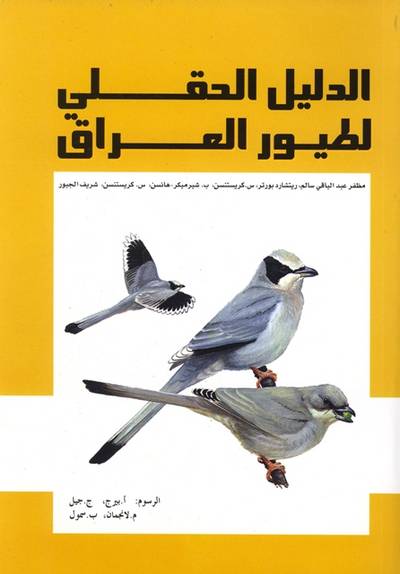 Field Guide to the Birds of Iraq - An important Milestone in Iraqi Conservation
Birdlife International and Nature Iraq announced the publication of the first Arabic language field guide to the country's 387 recorded bird species. In fact the Field Guide to the Birds of Iraq is the first comprehensive, fully illustrated guide to any Arabic speaking country. The book has been a collaborative effort by Nature Iraq (I know Mudhafar Salim worked hard on it as well as other biologists and field workers), Richard Porter, author of the Field Guide to the Birds of the Middle East (recently released in Arabic) and Birdlife International. Funding for the project was provided by The Canada-Iraq Marshlands Initiative, the Ornithological Society of the Middle-East, Avifauna and The World Bank.
Since I first heard of the project from my friend Mudhafar, I have felt that this would be an important and exciting step in increasing the Iraqi public's awareness of their natural treasures and giving added visibility to the country's environmental movement. With a field guide it becomes possible for large numbers of people to participate in studying the country's birds as the knowledge of identification is spread. Now we need an Iraqi eBird for large scale collection of observation data.
I naturally thought of my experience as a child looking through field guides and the spark it provided to my interest in nature. I also thought of my experience with children in Iraq when I visited schools to bring books and supplies. At the very least each school in Iraq should have a copy of this book. I imagine in the next few months and years, a child will crack open the Field Guide to the Birds of Iraq for the first time. First they will look for the familiar birds, the Laklak (White Stork), the Hudhud (Hoopoe) or the Wood Pigeon. They will come back to the book and see birds they never knew existed. For a few, the spark of curiosity will become a flame of a lifelong passion, perhaps when they realize these exotic creatures live, not in some far-off place, but in their own country. I fully expect that some of Iraq's next generation of naturalists and scientists will have started their journey when they discovered the world was larger and more wonderful than they had imagined when they opened this book.
I've discussed the idea of raising money to enable the widest distribution of this important book with a few people both here and in Iraq. I think it is a very important project and I'll follow up with some details as they are worked out.
Again, congratulations to all involved in the publication. I pray you reap a hundred-fold for your efforts.
Kosovo Questions
Once more it is the Balkans that is in the headlines. We are approaching the time when President Ahtisaari will present his ideas on Kosovo to both Belgrade and Prishtina.
And that will be the start of an intense period of diplomacy centered on Kosovo and Serbia.
On Tuesday evening I'm heading to Prishtina for some quick talks there during the Wednesday.
It is primarily Prime Minister Ceku and the UN head Ruckers who have expressed a desire to see me, and the best way of making that happen was for me to come down to them for some hours.
But I will also take the opporrtunity of seeing some others to get a better picture of the challenges abhead. That applies perhaps in particular to the economic situation of Kosovo which in my opinion should be given far more attention than is the fact.
There is the belief that if you take some sort of decision on the "status issue" you would automatically improve the economic and social situation. I fear that this is very far from what will happen, and that there is the risk of a rather rude awakening some time down the road.
And if you don't get a better economic situation for the inhabitants of Kosovo, I'm afraid that the political stability Kosovo so desperately need will also be in danger.
Today, approximately 60 % of the economy of Kosovo is based on money coming from abroad in different ways. That's a substantial increase in relation to the approximately 40 % it was during the Yugoslav years. But over the coming years there might well be a rather sharp reduction in these flows, and it will then be imperative that this is balanced by a dramatic increase in the activity of the domestic economy of Kosovo.
I want to know more about how the Kosovo instituitions are planning for the immense post-status challenges they will be facing.
And that will be the start of an intense period of diplomacy centered on Kosovo and Serbia.
On Tuesday evening I'm heading to Prishtina for some quick talks there during the Wednesday.
It is primarily Prime Minister Ceku and the UN head Ruckers who have expressed a desire to see me, and the best way of making that happen was for me to come down to them for some hours.
But I will also take the opporrtunity of seeing some others to get a better picture of the challenges abhead. That applies perhaps in particular to the economic situation of Kosovo which in my opinion should be given far more attention than is the fact.
There is the belief that if you take some sort of decision on the "status issue" you would automatically improve the economic and social situation. I fear that this is very far from what will happen, and that there is the risk of a rather rude awakening some time down the road.
And if you don't get a better economic situation for the inhabitants of Kosovo, I'm afraid that the political stability Kosovo so desperately need will also be in danger.
Today, approximately 60 % of the economy of Kosovo is based on money coming from abroad in different ways. That's a substantial increase in relation to the approximately 40 % it was during the Yugoslav years. But over the coming years there might well be a rather sharp reduction in these flows, and it will then be imperative that this is balanced by a dramatic increase in the activity of the domestic economy of Kosovo.
I want to know more about how the Kosovo instituitions are planning for the immense post-status challenges they will be facing.
Afghanistan, Lebanon and Kosovo
 Home in Stockholm again after a rather hectic but essentially succesful week. It was Brussels, Riga, Stockholm, Paris and then Brussels again.
The discussions at the GAERC - the Foreign Ministers of the EI - on Monday were primarily about assessments of the results of the election in Serbia and the implications they would have.
For me they were a clear victory for the reform- and Europe-oriented political parties. The extreme nationalists in the Radical and Socialist parties actually declined, although the Radicals remained as the single largest party.
Discussions about these issues continued in Brussels yesterday as we had a joint informal luncheon between the Foreign Ministers of Nato and the European Union - although the overlap is of course rather considerable. In essence it was the US and Canadian ministers joining all their European colleaugues in a very uselful talk.
But as we discussed Kosovo at that luncheon, our attention had been focused on the issues of Lebanon and Afganistan in previous meetings in Paris on Thursday and earlier during the day at Nato headquarters in Brussels.
President Chiraq was really successful in mobilizing international support for Lebanon at the Paris III conference. It was a significant international event.
And financial help is really needed if the country should have any possibility of coming back. It's still suffering from the consequences of its 18 years long civil war, and to this was then added the devastating conflict last summer. I was able to announce a further Swedish contribution of Euro 4,5 million.
It was an impressive gathering in Paris with good opportunities for informal discussions also on other subjects.
As one can see, the challenge of fragile and failing states, as well as national and ethnic conflicts in sensitive areas, requires an enormous amount of both attention and resources. We can not afford to fail in either Afghanistan, Lebanon or Kosovo since the consequences of failure will have ramifications over very wide regions.
For me it was my first visit in my new capacity to Nato headquarters, although it is of course a place where I have been many times before in different other capacities. But as a nation we now have a close partnership with Nato in the stability operations in Kosovo and Afghanistan, and there is the need for a much closer dialogue also on the political level.
Nato and the EU need to work closer together in the future. At the luncheon we all agreed that we have to tear down that invisible wall that divides Brussels into Nato and the EU. In Kosovo as well as other places there will have to be very close coordination.
And I will certainly be back at Nato within the not too distant future to continue efforts and discussions in this direction.
Wednesday, January 24, 2007
The Heretic & the Cause!
I never really had high expectations for the American venture in Iraq, because I have always known that the challenges of modernization and democratization are too enormous to be handled in such manner. Indeed, I do not believe in quick fixes and shortcuts when it comes to such major social transformations. There is no way around the mountain (or the abyss) for us in order to get to the other side, albeit it’s quite understandable that we should hope and pray for one. For the alternative is to do what others have done: go through hell in order to get what we want, what we think we deserve and are entitled to.
But then, some experiences cannot be had for free or on the cheap. All civilized peoples have had to pay dearly for their freedom and their democracy, and so will we. Democracy is not a cure-all, still we need it. It is not cheap, still, we have to get it even if we had to pay with our own blood for it, as we probably will, as we indeed are.
The debate over democracy might be over in some camps, true, but it hasn't yet really begun in the main ones – our streets, our minds, our psyches, our deeper recesses. So don’t count democracy out so soon. Just don’t expect us to get fucked, get pregnant then give birth all in the span of a solitary month!
The US adventure in Iraq and the region has clearly showed us that dictators are mere manifestations of our real problems, that our sectarianism is intrinsic and deadly, that bottom feeders are numerous and murderous and that our social and state structures are all too fragile. Yet, for all this, we need to change. If anything US failure underscores our deep and intrinsic need for change.
So, and while some insist on seeing in the US failure in Iraq (and the region) an ultimate failure for the cause of change and democratization in the region, I see it as the end of an unfortunate distraction and of a unique, though perhaps unnecessary, learning opportunity (at least for those of us who invested themselves in it even while knowing that it cannot possibly succeed). Now we can go back to the real business at hand, the business that only we can and should conduct. If the US, whether under a Democratic or Republican administration, wants to remain relevant to this business, it can always support us. This is what we have wanted all along anyway, the US support of the cause, not its hijacking of it.
Tuesday, January 23, 2007
Heretical Grief!
The reasons why I left the US in 1994 and went back to Syria after a 9-year long absence are many, but one of the contributing factors was the fear of losing one or both of my parents while I was abroad. This fear stemmed from two facts: I lost my paternal grandmother who doubled as my nanny really when I was studying in the Moscow in 1984, and all the phone calls that I made in 93-94 to my parents featured announcements of someone close dying: my step grandfather, my younger uncle (a gregarious life-embracing fellow – by far my favorite uncle), and two close family friends, one of whom, the late Syrian actor Yusuf Hanna, was like a second father to me. Not wanting to face another such loss while abroad, I chose to get back to Syria and stay there so I can deal with whatever loss as it happens and be there for those who need me, in both body and spirit, and so that I can take in the loss as well. After all, the passing of my grandma was something that haunted me for many years, my mind kept on treating her as though she was still alive and waiting for me back in her old-style Damascene house hugging Mount Qasayoun.
But then, when my father passed away in 2004, and though I was there for him throughout all his final night on earth, it didn’t feel like I was really there at all, not for him anyway. The vacant look in his eyes should have told me that he was dying, and should have compelled me to stay next to him and chat with him about anything and everything, but it did not. I just checked on him every now and then, throughout that night, taking a small nap in between, and allowing myself to be fooled by the look of recognition in his eyes and the smile that got painted on his face each time I entered his room. He was dying, and I did not want to see it. To top it off, next day noon, I left his side and went to the office, leaving him to the loving care of my mother and Khawla. A couple of hours later I received a call from Khawla telling me that they need me back, I didn’t ask why. I didn’t think why. But I soon learned that my father had passed away. So, I wasn’t really there after all, was I?
Still, when I think of my father these days, and it’s only natural that I should think of him at this point in time, after all January 17 marks the anniversary of his passing (not to mention my anniversary with Khawla), I have no delusions that he is still alive – I know he is gone, I can feel the void. Is that what it means to be there, or almost there?
Perhaps indeed this is the best that can be achieved in the face of such loss. Which, somehow, means that I am now back to square one, having left Syria once again, no matter how involuntary.
This morning, there was another phone call and a brief announcement. A maternal aunt has passed away. Ghada Wassef, 55, a small time actress, diabetic, overweight, gregarious, life-embracing, people’s person, helpful, kind, definitely my favorite aunt, passed away in her sleep due to kidney failure. She had already been admitted to a hospital on the previous day for a sudden increase in blood sugar, a routine occurrence in her case, just as death is part of life’s daily routine, I guess.
And I wasn’t there for her, or for that increasingly lonely mother I left behind. This is another facet of exile with which I have to deal. I can never be there to anyone anymore. Not that being there was any help, to others that is.
I am one of thousands in this situation, I know, yet this knowledge does not matter in the least. My choices in life will continue to bedevil and haunt me, and everyone around me for the rest of my life, and perhaps beyond - an enduring legacy of pain and abandonment. When will they ever make a difference, I wonder, or at least begin haunting those who deserve to be thus haunted?
Will my choices in life ever be justified, or do I have to stumble on blindly to my last days hoping that the path, semi-chosen if not self-inflicted, is, somehow by some reasonable standard of decency, right?
Monday, January 22, 2007
Notes on a New Scandal – in Iraq!
The situation is getting more serious by the day for the Syrians in Iraq, as many refugees live hand to mouth and spend their time moving from one willing friend’s place to another for safety as the hunt and the raids continue.
Today a new sign of coordination between Syrian and Iraqi security in this regard surfaced when the two sons of one of the most visible Syrian refugees and opposition members in Iraq, Muhammad Bakkur, were arrested in Hama in central Syria. Omar and Sufian had returned to Syria in 2003 following the US-led invasion of Iraq, the Syrian authorities had allowed at the time for a handful of refugees to return home as part of their campaign to polish the image of the regime. Their arrest today denotes the Assads’ growing confidence, defiance and possible coordination efforts with Iraqi counterparts. No wonder Talibani is calling on the US to engage them. The Assholes of the world have always had a pretty good sense as to when it behooves them to unite. This all too unfortunate tendency, it seems, has allowed the Assads to get back to their old habit of hunting opposition figures wherever they are allowed to reach. Failing that, revenge against more easily accessible family members is in vogue again. This should give much food for thought for people in my position, I guess.
On a related note, attacks on Palestinian refugees in Baghdad took place yesterday as well, which makes one has to wonder: first Syrians and now Palestinian refugees, is a deliberate policy of ethnic cleansing unfolding in Baghdad? If so, where will it lead? What’s Maliki’s government role in all of this? And what potential backlash could there be among the wider Sunni community (considering that all these refugees are almost exclusively Sunni)? Indeed, the re-engineering of Baghdad into clearly demarcated Sunni/Shia cantons have been taken place for a while now, with some success. Could this trend be part of it?
Should the Sunnis in the region perceive themselves as the target of some organized ethnic cleansing in Iraq, and considering recent developments elsewhere in the region where Sunnis were on the losing end (Afghanistan, Somalia, Gaza, etc.), the implications of such perception for the Global War on Terror and regional stability are very serious indeed.
Infelix Vates.
Sunday, January 21, 2007
Onwards to Brussels
 Later today I'm taking off for Brussels, preparing for the monthly meeting of the General Affairs and External Relations Council.
GAERC - as is the romantic description of this august body of the 27 foreign ministers of the European Union.
When we sit down in the Justus Lipsus building in Brussels tomorrow it will be to a rather heavy agenda dominated by the Balkans and the Middle East, but certainly dealing also with Somalia and Sudan as well as pre-viewing some of the core issues for the upcoming European summit on energy security and climate change.
From Brussels I'm flying directly tomorrow late afternoon to Riga in Latvia.
I have already been to Tallinn and Vilnius, and had been planning to go to Riga already earlier. It is important to reconnect the network of cooperation in the Nordic and Baltic area, and I certainly look forward to the talks I will have in Riga with the President, the Prime Minister and the Foreign Minister.
Riga is a true metropolis of the Baltic region that is now rapidly regaining its historic role. It's a splendid and truly booming city in a country with a growth record among the most impressive in modern Europe.
After a day in Stockholm on Wednesday I'm off to Paris on Thursday for the big international conference on Lebanon. It will be an impressive gathering also to show support for the position of Prime Minister Siniora, and I'm certain that the discussions in the corridors will be dominated by the broader Middle East issues.
From there I'm continuing to Brussels on Friday where there is a special meeting of the foreign ministers of Nato to discuss primarily the situation in Afghanistan.
We have a keen interest in these discussions since we are among the troop contributors to the ISAF mission there, and I'm looking forward to the lunchean that also includes the EU countries not members of Nato.
The Week That Was
 Last week turned out to be even more hectic than I expected - but also more fruitful.
I had a most useful visit to Belgrade and to Southern Serbia. With due respect to diplomatic conversations - it is useful to come out and meet the concerns of people in villages and farms and small towns. And that is what I did with President Tadic on Monday of last week.
What struck me most from these poor areas of Southern Serbia was the fact that every time the word "Europe" was mentioned there was spontaneous applause. You could feel and see and hear the soft power of the European Union during those meetings.
The ideologies of the past no longer appeals, and I believe that noy even the appeals to raw nationalism don't work to the same extent as before. It is dream of Europe that is the dream of a better future for many of the peoples of the Balkans.
It goes without saying that these expectations will be very difficult to meet. European integration can do a lot - but not everything.
But the very fact that these expectations are there is a powerful political fact - if they are ignored or rejected there are bound to be consequences. I would not rule out that such a situation would give the forces of raw nationalism a new life.
But it wasn't only Serbia and the discussions there - centred on what could happen after today's election - that were useful last week.
In Rome - apart from attending a big conference on Balkan policy together with Commissioner Olli Rehn - I had a very fruitful meeting with Foreign Minister D'Alema.
We broke all time schedules as we discussed primarily the Middle and the Balkans, but we also had time for an interesting exchange on developments in Russia. Our political backgrounds are very different, but I believe it is fair to say that we were very much on the same wavelength, and there is a good ground for a closer cooperation between Stockholm and Rome on a number of important subjects.
On Wednesday I was in Helsinki for more traditional informal talks on security policy. It was the foreign and defence ministers of the two countries meeting over a good meal at a manor house on the outskirts of Helsinki.
As usual between our two countries it was an excellent meeting of minds.
In terms of security policy our orientations and ambitions are very similar, with a more relaxed attitude towards practical cooperation with Nato than before, although there are differencies in the ways in which our respective defence forces have so far adjusted and been transformed.
And Thursday I spent - apart from the regular meeting of the government - mostly in the Riksdag debating different issues.
We had a long and excellent discussion on the situation in the Middle East, and it was worth noting that while there are certainly tensions between different interpretations of the basic situation in the area, there was a very broad consensus on the tasks ahead for European and Swedish policy in the area.
In this area, I see my task more as trying to shape the future than in trying to judge the past.
Subscribe to:
Posts (Atom)
