Some great clips from the "Lines That Divide" documentary.
Chuck Colson, Founder of Prison Fellowship:
"Lines that Divide is a much needed tool for equipping concerned citizens with a comprehensive view of the science and ethics shaping the stem-cell debate today. The film spotlights the breakthroughs being made by adult stem-cell therapy — breakthroughs which are not receiving equal funding or equal media coverage. All of us who believe in supporting life should see this film and recommend it to others."
Leading experts, William Hurlbut (Stanford University), Philip Schwartz, Wesley J. Smith, and Samuel Wood on the use of human embryos for research.
Christopher Reeve on Charlie Rose discussing human cloning. William Hurlbut on arguments made from suffering and the "greatest good for the greatest number".
Showing posts with label science. Show all posts
Showing posts with label science. Show all posts
Friday, June 19, 2009

Monday, May 25, 2009
Networks
Networks are everywhere
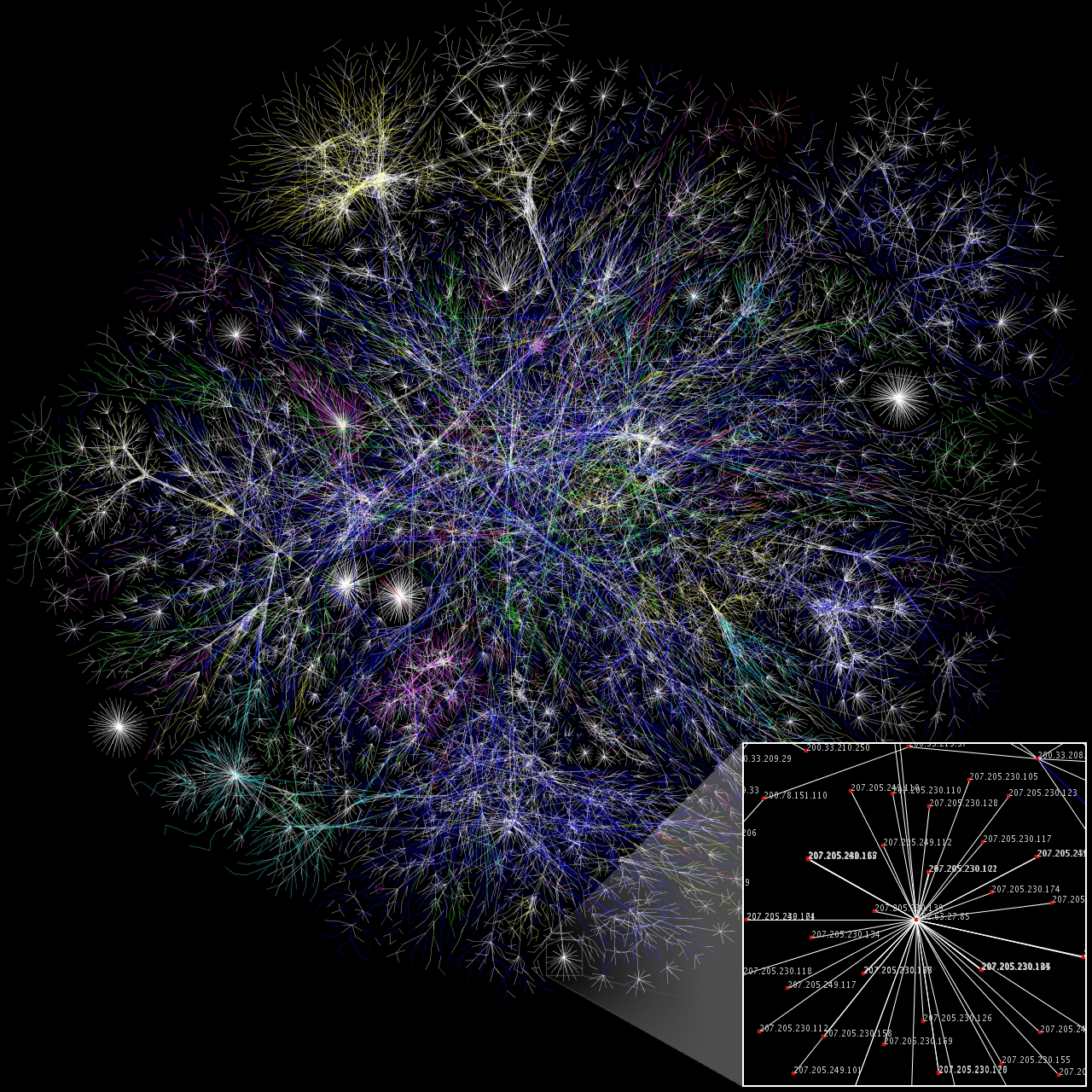
The study of networks and the related branch of mathematics, graph theory, have received an increasing amount of attention during the past few years. It's a highly interdisciplinary area, connecting the natural sciences with the social sciences, maths and the computer sciences. Did I leave out anybody who is interested in anything? Not so surprising, since networks can be found everywhere throughout our closely connected world: from computer networks and electrical power grids, to social networks, neural networks, to food webs - even the bible has a network:

[Click to enlarge. Via.]
Just consider the amount of different networks woven through your life: there's the route maps of airlines, the internet and its virtual link-structure, the world wide web (for example the blogosphere), the production and distribution processes of consumption goods, electricity networks and, of course, the sexual networks. And though they are different in many aspects, they share a similar underlying fundamental structure that can be mathematically captured and analyzed. Needless to say, with our rapidly improving capacities for storing and handling large amounts of data, the study of networks has flourished tremendously within the last decade.
What is a network?
Pictorially speaking a network is a collection of dots connected by lines. Physicists tend to call the dots nodes and the lines links, mathematicians call it a graph with vertices and edges, but it's the same thing really. The number of connections a dot has is also called the 'degree' of the node or, if you prefer, the 'valency' of the vertex. The great beauty of networks is their generality. From such a simple mathematical description one arrives at a great variety of structures and phenomena.
There are different properties a network can have:
There are two important special types of networks:

Network Science - what is it good for
So why am I telling you that? Because the analysis of networks can help us to understand many aspects of the inanimate and animate world whose interdependence obscures local analysis. In particular, the growth of specific structures and the dynamical properties of networks play an increasingly important role for managing large scale effects. Understanding the conditions necessary for resilience - may it be of a social, economical or ecological network - is essential to ensure stability of these networks that are vital parts of our lives.
While my enthusiasm about "complex systems" is limited due to the vagueness and ambiguity of a lot of of this research, network science is its backbone. Needless to say, there is some overenthusiasm also in this area. One thing I would like to know better for example is what the limits are of modeling systems as networks. With enough abstraction, I can probably describe everything as some sort of graph. But under which circumstances is that insightful?
This post was inspired by last week's colloquium by Raissa D'Souza from UC Davis on "Growing, Jamming and Changing Phase" that you find on PIRSA 09050004.
Further Reading
The study of networks and the related branch of mathematics, graph theory, have received an increasing amount of attention during the past few years. It's a highly interdisciplinary area, connecting the natural sciences with the social sciences, maths and the computer sciences. Did I leave out anybody who is interested in anything? Not so surprising, since networks can be found everywhere throughout our closely connected world: from computer networks and electrical power grids, to social networks, neural networks, to food webs - even the bible has a network:

Just consider the amount of different networks woven through your life: there's the route maps of airlines, the internet and its virtual link-structure, the world wide web (for example the blogosphere), the production and distribution processes of consumption goods, electricity networks and, of course, the sexual networks. And though they are different in many aspects, they share a similar underlying fundamental structure that can be mathematically captured and analyzed. Needless to say, with our rapidly improving capacities for storing and handling large amounts of data, the study of networks has flourished tremendously within the last decade.
What is a network?
Pictorially speaking a network is a collection of dots connected by lines. Physicists tend to call the dots nodes and the lines links, mathematicians call it a graph with vertices and edges, but it's the same thing really. The number of connections a dot has is also called the 'degree' of the node or, if you prefer, the 'valency' of the vertex. The great beauty of networks is their generality. From such a simple mathematical description one arrives at a great variety of structures and phenomena.
There are different properties a network can have:
- The links between the nodes can just be connectors that are on or off, or they can be arrows indicating a preferred direction, called a 'directed graph'. Links on websites for example have a direction, friendship networks on Facebook don't.
- Both the nodes and the links can carry information, eg about what is produced in the nodes or transmitted in the links.
There are two important special types of networks:
- Random: A random network is one in which from a collection of nodes pairs are picked randomly and connected.
- Scale free: A scale-free network is one in which there is a specific relation between the number of nodes and their degree, called a 'power law'. In these networks, there are a lot of nodes with only a few links, and a few nodes with a lot of links - these are also called 'hubs'. Real world networks, eg the www or airline networks, turn out to be often scale-free (to some approximation) with consequences for their robustness and vulnerability e.g. the spread of viruses or the dissemination of information.
Network Science - what is it good for
So why am I telling you that? Because the analysis of networks can help us to understand many aspects of the inanimate and animate world whose interdependence obscures local analysis. In particular, the growth of specific structures and the dynamical properties of networks play an increasingly important role for managing large scale effects. Understanding the conditions necessary for resilience - may it be of a social, economical or ecological network - is essential to ensure stability of these networks that are vital parts of our lives.
While my enthusiasm about "complex systems" is limited due to the vagueness and ambiguity of a lot of of this research, network science is its backbone. Needless to say, there is some overenthusiasm also in this area. One thing I would like to know better for example is what the limits are of modeling systems as networks. With enough abstraction, I can probably describe everything as some sort of graph. But under which circumstances is that insightful?
This post was inspired by last week's colloquium by Raissa D'Souza from UC Davis on "Growing, Jamming and Changing Phase" that you find on PIRSA 09050004.
Further Reading
Thursday, May 21, 2009
Does Living Abroad Spark Creativity?

Ernest Hemingway at the Finca Vigia, Cuba, 1953, JFK Presidential Library and Museum
A recent piece in The Economist highlights a study in the Journal of Personality and Social Psychology that suggests living abroad may do wonders for your creativity. The results certainly seem intuitive. I've lived abroad and the experience shook up my influences. But, not so fast says Jonah Lehre on his blog, The Frontal Cortex. He thinks the conclusions in the study may be sketchy and cites issues of causation vs. correlation and using email as a testing tool as factors.
This matter is too important to leave open for debate. We need certainty and I'm willing to step up and be a guinea pig. Scientists, please send me to Spain with my camera, pump me full of sangria and hook me up to any all manner of diodes and testing apparatus you have. Let's get to the bottom of this pressing scientific matter once-and-for-all.
Subscribe to:
Posts (Atom)