Thursday, July 31, 2008

India Art Summit 2008, India's modern and contemporary art fair


India Art Summit™ 2008 has received an overwhelming response with over 90 applications from galleries and art businesses. The art fair will house 34 of the best exhibitiors of Indian art representing over 12 regions from India & overseas. The India Art Summit™ will therefore showcase the most diverse range of modern and contemporary paintings, sculpture, photography, mix media, prints, drawings and video art by veterans and upcoming artists from across the country. The 3 days in August will see the largest congregation of art collectors, a new wave of investors and art lovers from different geographies.

There will also be a day long interactive seminar with internationally renowned speakers like Dr. Robert Storr, Dr. Hugo Weihe, Mr. Philip Hoffman, Ms. Geeta Kapur, Prof. Rajeev Lochan, Ms. Anjolie Ela Menon, Mr. Arun Vadehra, Mr. Dinesh Vazirani.

PROGRAMME DETAILS:

22nd August 2008 (Friday)

11:00am - 2: 00pm (Collectors Preview by invitation only)

2:00pm -8:00pm (Fair open)

23rd August 2008 (Saturday)

11:00am - 8:00pm (Fair Open)

10:30am - 6:30 pm (Day long seminar)

7:30 pm onwards (Cocktails and Dinner at Intercontinental The Grand - by invitation only)

24th August (Sunday)

11:00am - 6:00pm (Fair Open)
Looking for quality art works from upcoming young artists? just step in...
ASHOK ART GALLERY
STALL NO - A-30
India Art Summit 2008

Tuesday, July 29, 2008

Anas, my dear

Some say he looks like me :) I can't see it but I'm happy about it!


Posted by Picasa

Monday, July 28, 2008

Master Image Maker

When I read the sad news of Youssef Chahine’s passing, a stream of images from his films passed through my mind’s eye, fragmentary and disjointed images that have stayed with me over the years. The scenes are nearly all in black and white; some are hilarious and others sombre, some are central to the drama and others peripheral, some I remember for their sheer beauty and others because they drove me to tears or deep laughter. Since there’ll be many commemorations and obituaries in the coming days, and repeated overviews of Chahine’s oeuvre, here I want to focus on some small details. These are eclectic, personal favourites, my way of remembering a spirited, restless artist who loved his craft and loved Egypt.

In Chahine’s second film Ibn al-Nil (Nile Boy, 1951), shot on location and made when he was only 25(!), I love the panning shot of the young Hemeida racing through fields dotted with gorgeous palm trees to get to the station and watch the train pull out, the defining symbol of freedom and flight from the sleepy village life he hates. In the next scene, the camera moves away from the young Hemeida standing on the platform then moves back in to see the older Hemeida standing in the same place in the same pose. The older Hemeida is played by a youthful Shukri Sarhan in a wonderful turn as the sullen rural boy who grudgingly marries then abandons Zubayda (Faten Hamama) for the big city.

There are many scenes to love in Sira’ fil Wadi (Struggle in the Valley, 1954), again shot on location (in Luxor), but my absolute favourite is the one when Faten Hamama and Omar Sharif first meet (of course). This is the most romantic scene I’ve ever seen on film, effortless, charming, masterfully directed and gracefully acted. An impossibly handsome Omar Sharif (in his first screen role) plays Ahmed, the young agricultural engineer who helps the farmers produce a superior sugarcane crop that bests the harvest of Taher pasha, played by the deliciously evil Zaki Rostom. Amaal is the pasha’s daughter and a childhood playmate of Ahmed. They reunite after an 8-year absence on Amaal’s return to the village; I’ll always remember Ahmad calling out to her “Batates!”, her nickname from their childhood banter. With this film, Chahine not only created the most dashing couple in Egyptian film (and real life), but he gave us some stunning images of the countryside, images that were later echoed by Atef Salem in Struggle on the Nile (1959) and Barakat in The Nightingale’s Call (1959) and al-Haram (1965). One image I can’t forget is the procession of villagers grieving over their flooded crops, put to a haunting score of sorrowful humming and portentous drums.

Inta Habibi (1957) is barely mentioned when people review Chahine’s work, but it’s a comedic and cinematic gem, rivalling Fateen Abdel Wahab’s best comedies while crafting some indelible images of the landscape and people of Aswan. The priceless scene when Mimi Shakib and Serag Mounir enlist the milkman and the manservant to awaken their son Farid has me in stitches every time. Only a year later, Chahine produced the vastly different Cairo Station, a loving rendition of the invisible porters and peddlers trying to survive in Cairo’s teeming train station. This is where Chahine himself memorably played the lonely, limping newspaper boy Qenawi, in love and obsessed with the flirtatious soft drink seller Hanouma (Hind Rostom), who has her eyes set on the virile and aggressive Abu Sri’ (Farid Shawqi).

Directors before and after Chahine have had a love affair with filming in trains and on platforms (my absolute favourite is the final scene of al-Bab al-Maftuh, 1964), but I don’t think anyone came close to Chahine in exploiting trains’ range of aesthetic possibilities. The famous, tragic denouement on the empty tracks is what I remember most about Cairo Station, especially the intervention by the great thespian Hasan al-Baroudi.

I can’t remember any scenes from Chahine’s later films after Eskenderiyya Leih? (I haven’t seen Heya Fawda), probably because I just didn’t understand them. I like inventiveness and formal experimentation, but I was put off by the later films’ excessive allusiveness, campy style, and aggressive didacticism. Chahine’s autobiographical turn after Eskendriyya Leih? struck me as less compelling than his gift at probing Egypt’s landscape and the textured lives of its inhabitants. And he seemed less capable of eliciting excellence from his actors than he had in earlier films (and no wonder, if he was working with the likes of the horrid Nabila Ebeid).

When I was a child and first saw al-Ard (1969), I didn’t understand it but cried during the iconic final scene of Muhammad Abu Swaylam mercilessly trussed up and dragged by a mounted policeman, his bloodied fingers digging tracks into the soil, just as a village notable had ominously predicted in an early scene. When I watched the film again today, I saw a penultimate scene no less powerful. As government troops chase and beat down fleeing villagers, Abu Swaylam stands still in the midst of his field, a spectre of a smile on his stoic face. A close-up shows drops of his blood sliding off the back of his hand and landing on the snow-white cotton plants, the fruit of the earth he refuses to part with.

Youssef Chahine didn’t create the character of Abu Swaylam, that’s Abdel Rahman al-Sharqawi’s brilliant doing. But Youssef Chahine embodied this willful, reticent fellah in the peerless Mahmoud al-Meligi, directing him in a masterful, transcendent performance that brought me to tears again. For this and his many other enduring, wondrous creations, we can all be grateful.

Thursday, July 24, 2008

3024-003

Martyn
"Natural Selection (Flying Lotus' Cleanse mix)"
"Vancouver (2562's Puur Natuur dub)"

3024-003, dist. by ST Holdings
out in September

Monday, July 21, 2008

Amna Ilyas, the young women artist from Lahore,Pakistan

The human world has always been changing, but the pace of change seems to have picked up dramatically in the last decade or two, with no stability visible on even long-range scanners. Rapid change is obvious in all of the technological, political, business and social fields, and there are changes in our environment and ecosystem that are probably caused by this increasing human activity. All these reflects on contemporary art practice around the world.Here is Amna Ilyas , young women artist from Lahore, Pakistan.Amna Ilyas graduated in 2003 from the National College of Arts, Lahore and since then have been working as a sculptor / Painter in her studio. She exhibited at various venues both in India and Pakistan, and currently teaching Foundation Sculpture Course at her Alma meter.

Unlike many other places, it is difficult for a sculptor to survive in Pakistan, mainly due to various religious, social and economic restrains. But Amna has been pursuing her career as a dedicated sculptor, and seeking to explore the medium in all its possibility, and besides her time at sculpting , she is also creating number of paintings and drawings on her subject women. Last year she has visited India for an artist residency to practice her metal casting and ceramic skill and also exhibited her work at Ashok Art Gallery as a part of International Contemporary Art Exhibition. Her works were exhibited with works from USA, The Nederlands and India. On this year 2008, She has exhibited at Pakistan, her works were showcased at Art Expo India in March at World Trade Center, Mumbai by Ashok Art Gallery and most likely going to showcase at India Art Summit 2008 in August at New Delhi.

In its essence the work of Amna Ilyas represents the state of women in our society. Female figures in various postures reflect the conditions of an ordinary woman, yet the work does not propagate a direct message or illustrates the obvious political/social factors. On the other hand it alludes to the situation along with an undercurrent of beauty, sexuality and sensuality.

In my opinion Amna Ilyas is a significant artist of her generation. Her dedication to her art and the serious approach to her issues guaranty a bright future for her.

Contemporary Art Reviews: Ashok Art Gallery

.

On The Book Project

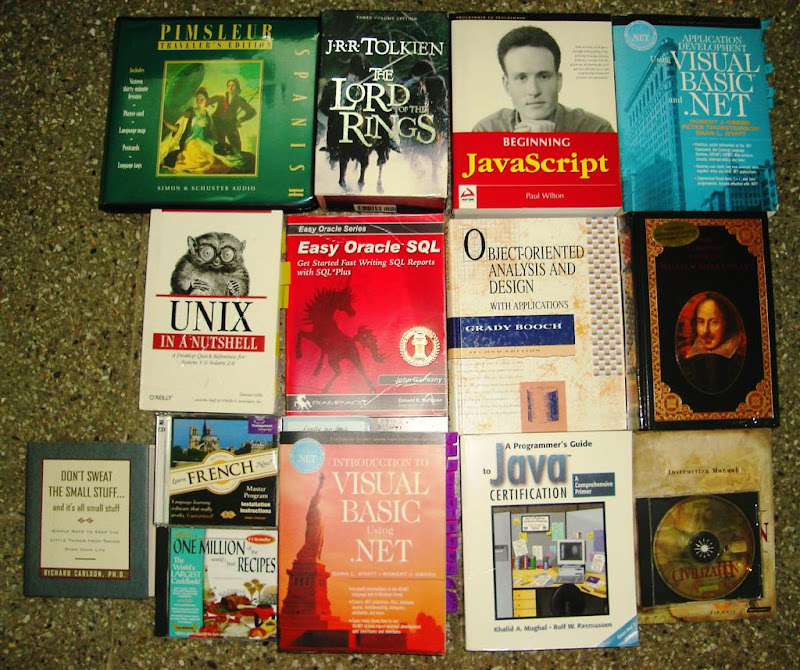
This is the last package I've received, from dear fellow blogger Fayrouz. I received it more than a week ago but I've been too busy and/or lazy to post about it.

The collection is absolutely great but I'm having a hard time deciding where to put the civilization (game and manual)! I also wonder if putting LOTR in the university's central library will do it justice!

Saturday, July 19, 2008

What's happening?

Between 2006 and today, we've had so many events and a whole lot of visitors.
Ayman was born.
I finished my sixth year at school.
Grandma and grandpa came to live with us thus we had the most busy Eids for two years.
Grandpa died.
Anas was born.
HNK finished her sixth year at school .
Dad had two operations (people come before the operation and after the operation) .
Grandma left to the UAE .
Mom's uncle died few days ago.
and today my aunt is coming from Baghdad to attend my cousin's wedding but she's staying at our house thus people are visiting her here.
Thousands of visitors, and no, I'm NOT exaggerating! I am likely to throw a tantrum if any more events happen soon.

Mom has noticed that we've had little to no freedom these two years, herself too, especially under grandma's dictatorial regime.. and since we've already been to Syria three times the plan was to visit Turkey this year.. 15 days in Turkey inshallah, early next month, finally. We had planned to visit Turkey 3 years ago, paid the money and were all ready but then the tourism company had problems and all was canceled. We'll see how it goes this year.

This vacation has been, nonetheless, very good for me.. I have been enjoying my time and I don't think I ever got bored. I got myself busy with reading novels and learning Visual Basic .NET and both were enjoyable. Few days ago however, my uncle lured me into learning Java instead of Visual Basic .NET, he said if I get really good then next year he'd give me work. /*See uncle I've already documented that so you wouldn't forget :) */ Today is day 4 of reading Java (I started the very next day he told me to learn Java, successfully overcoming what I think was separation anxiety!) but I'm not sure I'll be able to read anything today. I have stopped reading novels and devoted all my attention to learning Java and I really don't want to go to Turkey until I have some decent knowledge of the language.

Thursday, July 17, 2008

100% Carbon Free Electricity by 2018

We need a massive increase in electricity generated from alternative energy.

Here's Al Gore's vision:


Here's one way to achieve 100% Carbon Free Electricity

Thoughts?

100% Carbon Free Electricity by 2018

We need a massive increase in electricity generated from alternative energy.

Here's Al Gore's vision:


Here's one way to achieve 100% Carbon Free Electricity

Thoughts?

Mary Anne Hobbs BBC Radio1

On July 9th myself and romanian producer TRG were featured on Mary Anne Hobbs Experimental show on BBC Radio 1. The feature is a 30 minute one-take mix with a few added sounds here & there and I premiered the new Flying Lotus & 2562 remixes scheduled for 3024-003, as well as my remix of Flying Lotus' magnificent "Roberta Flack" from his Los Angeles album on Warp!

Standardly, Dave from Lower Depths came to the rescue and is hosting the mix here. If you want to download the full 2hr show you can find that here. Enjoy.

Martyn @ Mary Anne Hobbs Experimental show BBC Radio 1 - 9 july 2008


1. can - future days (carl craig blade runner mix) (white label)
2. martyn - vancouver (3024-002)
3. martyn - hear me (3024)
4. 2562 - old town (unreleased)
5. pangaea - router (unreleased)
6. martyn - twenty four (3024-001)
7. flying lotus - roberta flack (martyn's heart beat mix) (warp)
8. martyn - vancouver (2562's puur natuur mix) (3024-003)
9. martyn - natural selection (acapella) (3024)
10. martyn - natural selection (flying lotus' cleanse mix) (3024-003)

A Personal Story

Saturday, July 12, 2008

Videos from IdentityCamp Bremen: Caspar Bowden and Gerrit Hornung

Caspar Bowden, Microsoft's Chief Privacy Advisor for Europe, the Middle East and Africa, gave a presentation at the Identity Camp in Bremen. He talked about U-Prove, a zero-knowledge technology Microsoft recently bought from Dutch-Canadian cryptographer Stefan Brands who now works with Kim Cameron in the identity and access group. Caspar explained how U-Prove will be streamlined with Microsoft’s identity strategy and Cardspace.

Another interesting presentation was given by legal expert Gerrit Hornung from Kassel University's Project Group on Constitutional Technology Design. He explained the recent German Consitutional Court's ruling on secret online searches, which established the new basic right to the "integrity and confidentiality of information-technological systems". Gerrit also discussed how this may apply to other circumstances beyond searching hard-drives.

Lars Klatte was so kind to record some sessions and even do some video post-production. Watch the videos.

Direct download (m4v) of Caspar's lecture.

Thursday, July 10, 2008

Birding the VBC

I think the future "Where to find birds in Iraq" will have to include the cluster of bases near Baghdad International Airport (Victory Base Complex). These include Victory, Liberty and Slayer. I would guess that the aggregate list could be approaching 200 species between all the folks who have been watching birds there in the last 5 years. Some of these include White-headed Duck, Great White Pelican and Darter. The ponds, reedbeds and trees make it a nice migrant trap for waterfowl, shorebirds and passerines. For a while, there were even articles in the local base paper on the common birds seen around the area.

Matt Pike took some great pictures of many species while there. He has a gallery of around 120 species with fantastic photos. He saw species such as Darter and Basra Reed Warbler.

Many of the messages and photos on the Operation Iraqi Birds forum started by John Duresky relate to observations at VBC.

There are also recent photos and posting from LTC Bob from his second tour at VBC. His entire archive can be found here.

Tuesday, July 8, 2008

Indian contemporary artists were exhibited at Jumeirah,Dubai


The exhibition of modern figurative art at the 1x1 Art Gallery in Jumeirah, Dubai has showcased the ways in which urbanization has left its imprint on the minds of Indian contemporary artists .
INDIAN ART is of great vital importance in accordance to its culture and heritage.
Art is of various types and it changes its style of expression in the hands of different painters in relation to the changing time. Presently modern and figurative art is in high demand not only in India but also abroad. Modern form of painting is the result of the experimentation that the stalwarts of art have initiated.
The various forms of this experimentation were displaied in the collection of works by nine young contemporary Indian artists, at the 1x1 Art Gallery, Jumeirah, Dubai..
The exhibition, sponsored by the Dubai-based Rivoli group, ended with a great success on last June 30. Among the artists featured were Prasanta Sahu, Dileep Sharma, T M Azis, Pooj Iranna, Murali Cheeroth, Biju Jose, Babu Eshwar Prasad, Pratul Dash and Gigi Scaria

Pratul Dash, an Indian painter from the state Orissa, also focused on varied modern themes: socio-political, socio-economical and ecological. His concerns are linked with the anomalies of human conditions and the effects of growth and development on human life.
The exhibition had two of his paintings on display. Through his work he comments on aspects of modern life, such as growth, absence of greenery, deforestation, the tendency to rise vertically rather than spread horizontally.
“Where there is development, there is also destruction. When I paint huge constructions, they are not just constructions; they are different levels of exploitation, and I try to portray that in my work,” explained the painter, who is a graduate of Fine Arts from Bhubaneswar, Master degree from Delhi and has also studied in Italy. Besides many exhibitions in India, his works are exhibited at USA, UK, ITALY, HONG KONG and now at DUBAI.

“For instance, living space is the most critical space by itself where people can play different roles. It’s like construction blocks, there is no greenery there. It is like pigeon holes, a squeezed existence. And I have commented on this aspect.” Dash said. Dash said he is not against development but his concern is: development at what cost? “For example, there is so much deforestation that has taken place in the name of development,” he pointed out.
“So, my aim is to make viewers disturbed, make them think. I feel artists have a sort of responsibility to jolt people. I comment on aspects of urban life that should worry us. I’m not here to paint pretty pictures.”

Monday, July 7, 2008

The Quest for Life


Mahmoud Mokhtar, Return from the River
Limestone, 1928

Thank You

I got my final exam results today and it made me feel like the luckiest person, in Mosul at least.

My marks were great, the professors' reactions were great, everything was great.. it was like a dream. I always hoped and prayed for them and having them in reality was ever so sweet. I got excellent marks (over 90%) in all the subjects except for Human Rights (aka Education) and Lab in which I got very good marks (over 80%).

Your prayers certainly played a big role in this.. I would like to thank you my dear readers, and the very good friends who kept encouraging and believed in me even when I stopped believing.

And there's a BIG thank you to my dear dear professors.. and a special one goes to my Electronics professor, I'm really glad I didn't disappoint you ;)

Now I'm feeling like I'm giving a speech in the Oscars or something.. feels silly and I'm going to stop, they're probably playing some music to make me stop now ;)

Sunday, July 6, 2008

The Tragic Hero

This weekend the 2008 edition of the Tour de France started. The first few stages of this fascinating cycling race made me think back of my favourite riders from way-back-when, the "coureurs" who could make those 6 hour long mountain stages worth watching. History has seen many great riders, but my all-time favourite must be Italy's Marco Pantani.

Pantani's life, on and off the track, is intriguing to say the least. Journalist Matt Rendell wrote a great book about it called "The Death of Marco Pantani". Nicknamed "il Pirata" he was one of the most talented climbers in cycling history, Armstrong's main rival and an Italian national hero. His name however was also connected to doping scandals, he got caught red handed during 1999's Tour of Italy, retired from cycling in 2003 and sank into terrible depression and drug use. In 2004 he was found dead in a hotel room in Rimini, the cause of death was heart failure due to acute cocaine poisoning.

In his book Rendell points out Pantani was absolutely unable to cope with the amounts of attention his every move received in the media and the pressure to win from his fans. After the doping scandals he was involved in, shame and "the weight of the world on his shoulders" made his tendency to self destruct overpower his will to live.

Pantani's "tragic hero" life story does not stand on itself. In sports, but even more so in music, there are many examples of artists who are mentally unable to deal with excessive (media) attention and fame. It seems that some sort of internal mechanism kicks into gear that just wants to destroy whatever has been achieved, instead of enjoying it or expanding it. More recently, Amy Winehouse seems to be following the same path as Pantani, or Janis Joplin, Jimi Hendrix, Kurt Cobain, Ian Curtis (pic), the list goes on and on.

This has always fascinated me. Is it a form of extreme insecurity, that when the eyes of the world are upon you, it becomes increasingly more difficult to progress or even sustain what you have achieved? That you need to escape from this insecurity (for instance by obsessive drug use) to make yourself feel better (even if only for a short amount of time) or to numb yourself to influences from the outside world? It's likely. Also, the realization that you are lived by the people around you, that you have no control over where you want to go and what you want to do, could explain why you take charge of and destroy the one thing no outsider could possibly control : your physical and mental wellbeing.

Why is this self-destruction mechanism present in some of us, and not all of us? I could name many artists in history that have lead a long life, died of natural causes and left a legacy of great inspirational works of art. To go back to Marco Pantani, Rendell's book points out that in Marco's childhood there were already clues of bi-polar disorder and manic depression, and that his jump to fame only accelerated the symptoms. So there must have been something at the root of it all. In other "tragic hero" stories you will find childhood/early teen experiences that explain the final chapter of one's life.

It is an assumption, but perhaps fame is not the cause for someone's demise, but merely the catalyst and accelerator of an already existing mental issue. So there is no escape. The tragic hero is doomed from the start.

Fundamentals #01


A group show at MU, Eindhoven with:

Matthias Wermke/ Mischa Leinkauf (D)
Erosie (NL)
Boris Tellegen (NL)
Olivier Kosta-Théfaine (F)
Influenza (NL)
François Morel (F)
Honet / Allergy / Nicolas T. (F)
Navid Nuur (NL)
BLU (IT)
Honet (F)
Jeroen Jongeleen (NL)

18th of july - 17th august