Showing posts with label book project. Show all posts

Thursday, April 2, 2009

Update on The Book Project

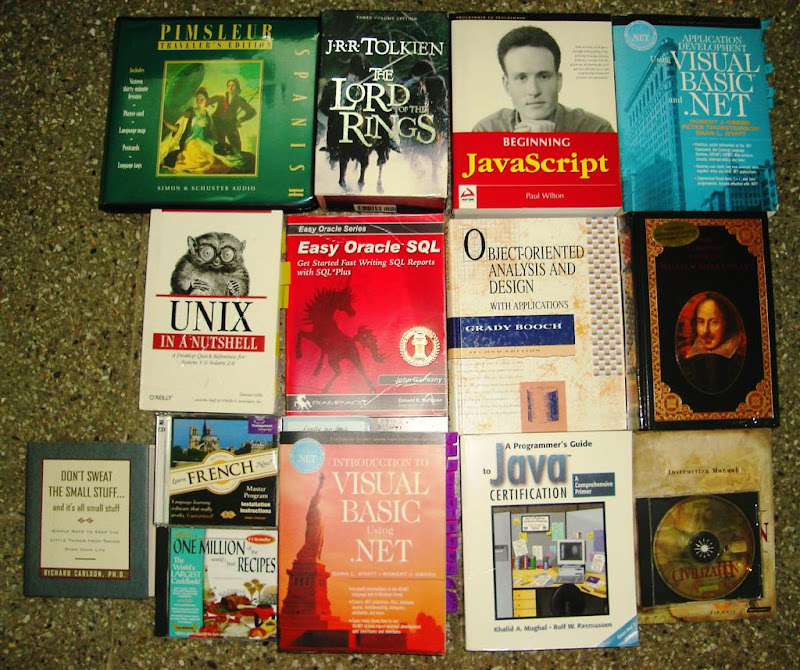
This is the first package of books we've bought with the donations money.. It's quite a good collection. It took a really long time to arrive but it finally arrived in perfect condition. I received the books about a month ago but was too busy to report that.

An Iraqi in Malaysia bought the books and donated some of his own. Books in Malaysia are very affordable as they have international copies.. the amount of money used to buy the books was approx. 300$.
I'm taking the donations button off the blog since I'm not sure how long it'll take me to spend the rest of the money, we have 621.40 USD left!

Thanks all for all the efforts!

Friday, February 20, 2009

Publishers, Update your Business Model!

Book publishers, I think your business model is expiring! If you don't update it now, you will suffer the same fate as the music industry: "cluelessness" of what to do to fight steeply declining revenues!

I am by no means an expert of the book publishing industry. My only qualification is being a huge buyer of books and being an aspiring author with a business model innovation book I am working on. The innovation behind the book: I am not alone in writing this book, but my co-author and I are working with another 250+ co-authors who paid to be part of the book writing. Oh, I almost forgot, we not working with a publisher... I never even submitted a manuscript to a publisher...

Here four substantial trends off the top of my head that will rock the book publishing industry and their business models (trends which you probably know, but are not taking seriously):

Distribution is a commodity and attention is scarce

Publishers and retailers used to controlled distribution. That gave them the power to promote authors and their books. With Amazon.com, self-publishing sites such as Lulu.com and the rise of e-books that power is gone because anybody can (print and) distribute a book. The name of the game is now capturing attention in a world of abundance and the absence of distribution scarcity. The publisher’s role of the gatekeeper is soon gone. We are entering the ultimate meritocracy. Books will be successful without a major publisher if they can capture the attention of potential readers through the mastery of the tools of the attention economy: blogs, communities, search engine optimization (SEO) and viral marketing. Readers will catapult a book to success if their attention can be captured. We have already seen this happen sporadically in the music industry.

New business and revenue models will dominate the landscape

Traditional revenue streams from selling books are prone to die. Learn from the music industry: Apple is now the dominant force in digital music and has replaced the incumbent players with a completely different business and revenue model. They sell music online, but they earn most from selling their iPod hardware. Or look towards the artist that give away their music and earn their revenues from increased concert sales or special edition albums. They use “free” as a way to capture attention and earn from new revenue streams.

Authors want to be liberated from the handcuffs of publishers

Very few authors get lucrative royalties or a substantial advance from their publishers. Royalties usually run around 5-10% of the book price. You have to sell VERY many books to live from it decently. In addition publishers don’t allow you to do most of the interesting stuff: experiment with new formats, revenue models and online communities. Hence, new authors have little interest to work with publishers and many of the most lucrative successful authors will run as soon as they have the courage: Paulo Coelho is famous for his stance against the publishing industry and their traditional methods.

New experimental formats will emerge

Books will be written by communities, they will come in versions (like software: cf. the unbook movement by my friend Dave Gray), they will have innovative intellectual copyrights (e.g. creative commons) and novels will have multiple endings. They will take advantage of multimedia by integrating online content and they will be delivered to digital readers like the Kindle. There are absolutely no limits to imagination of how the “books of the future” will look like. Sadly, publishers (with notable exceptions) lack the required imagination to exploit the new opportunity space.

UPDATE
: Richard Baraniuk's talk at TED on textbooks: Goodbye, textbooks; hello, open-source learning:
http://www.ted.com/index.php/talks/richard_baraniuk_on_open_source_learning.html


Friday, January 9, 2009

The Future of Management Books

There are a lot of good management books out there and I'm looking up to many of the leading authors. I particularly admire thinkers like C.K. Prahalad (Bottom of the Pyramid), Gary Hamel (Future of Management) or Tom Kelley (Ten Faces of Innovation), to mention just some. Yet, even those outstanding personalities have not really changed the genre of management books. It's high noon to do so.

The management book as it looks today is mainly due to past restrictions regarding printing and media. It is usually written by a limited group of persons or a single thought leader and it is published with a lot of black & white text and few images. This is the norm, though there are obviously great exception (John Kotter's "Our Iceberg is Melting" or Tom Peters' "Design Essentials").

Here is my take on how a management book should be crafted and how the result should look like. I try to apply this in my own management book that I am writing together with Professor Yves Pigneur on business model innovation.

The 4 design essentials that the NEW management book should follow:

Visual Thinking & Design:
The majority of management books as we now them today only rely on few visuals. This is mainly due to past restrictions in the printing industry. Authors of management books should use images much more because the visual sense trumps all authors as John Media outlines in his excellent book on brain rules (see rule #10). Images allow the simplification of concepts and they make it possible to convey emotion (e.g. change, urgency, competition). Personally, I believe it is not enough to have some graphs and 2x2 matrixes. We need a compelling visual design to make useful management books. For that purpose our book writing team includes a designer and the participation of XPLANE, the leading company in visualizing business strategy and management.

Co-creation: Management books should be co-created together with the end-user. Though authors usually have a pretty clear idea of what they want to convey in their book, I believe they should still integrate the reader as part of the book creation process. Yves and I are doing this through an online platform (called the Hub) where we share chunks of the book as we write them and then allow people to give feedback on each piece. We are doing this to integrate the valuable experience of our readers, to test ideas and start building a community of practitioners around the topic. In a month over 160 people have paid 24.- $US to be part of this process!

Prototyping: The method we use to co-create is prototyping. We see the book chunks that we share on the Hub as prototypes that we test with the members of the platform. This includes testing the content as well as the form, since in our book both play an essential role. Conveying a message through a more visual presentation must be tested by the end-user, the reader. Does it really work? Do people "get it"? The amount and quality of feedback that we got from our 160+ Hub members on our first book chunk was wonderful. It's amazing how people get involved.

Applicability: Ultimately, a management book should help a person better manage his work, team or organization. Hence, the easier a management book makes it for the reader to apply the concepts conveyed in the book, the better it is... I think this is still a relatively weak point in the majority of management books - even in those with some of the most powerful concepts. Let me be clear, applicability is about limiting the effort the reader needs to make to translate the concepts conveyed in the book into applying them to his own work setting. In our own book on business model innovation we are aiming at making all we write applicable. As a consequence our book will look more like a manual for business model innovation. It shall include workshop scenarios, use cases and exercises to practices business model thinking.

Well great, now I've raised the expectations for our book once again... Join our book chunk project if you want to judge our ability to achieve the above design essentials. For 24.- $US you get some great privileges and the opportunity to participate in the future of management books ;-)


Monday, December 1, 2008

Business Model Innovation Book - buy early access to raw content now!

In MayEnd of August 2009 Yves Pigneur and I will bring a new management book to the market, which will be a beautiful manual for entrepreneurs and executives about business model innovation.

The interest we are getting for the book is staggering, because our business model innovation methods are already in use in companies such as IBM, Deloitte, Telenor and more. Our aim is to write a book that is visual & simple, applicable, relevant and full of exciting examples.

If you are interested in the topic you now have the exclusive possibility to get early access to the book content and a community of business model innovators. It is a unique opportunity to participate in the makings of a management book that has the potential to become a global bestseller. Working title: "Crafting Innovative Business Models" "Business Model Generation" (ideas welcome).

We will float and discuss the book content as it emerges on www.businessmodelhub.com. Access will only cost you $US 24.- $US 36.- $US 54.- $US 81.- $US 121.50 (the price increased because we exceeded 100 200 300 400 450+ subscribers )


By joining you will have the following privileges:
  • first & exclusive access to raw book content as we write it on www.businessmodelhub.com
  • FREE digital version of the full book when it is published
  • opportunity to influence authors and join content discussions
  • personal mention of your participation (names of participants' in print version in order of sign-up... so you better hurry ;-)
  • about 8 18 installments of book chunks (in a non-linear order as they emerge)
  • 50% discount off the FREE final book
  • access to templates and exclusive PowerPoint slideshows
  • being part of the business model innovation community
When you buy access for $US 121.50 we will invite you to the book chunk platform www.businessmodelhub.com within 48 hours. There you will be able to access everything that is going on. The first "book chunk" is due mid-December and is currently in the making. Already now there is a discussion on the book platform about examples, book format etc. 13 book chunks are online. This is the last opportunity to participate and get your name into the final print version book of this amazing breakthrough project.

Don't miss out on being part of a potential management book bestseller. You will even be able to prove it because your name will be mentioned in the print version!

On Monday January 19. 2009 at 17:00 (CET, Zurich/Geneva) we will hold a free webinar to explain how the book chunk project works.

Monday, July 21, 2008

On The Book Project

This is the last package I've received, from dear fellow blogger Fayrouz. I received it more than a week ago but I've been too busy and/or lazy to post about it.

The collection is absolutely great but I'm having a hard time deciding where to put the civilization (game and manual)! I also wonder if putting LOTR in the university's central library will do it justice!