Showing posts with label business model. Show all posts

Saturday, April 4, 2009

Obstacles to Business Model Innovation

At each of my workshops we usually discuss what the obstacles to business model innovation are in companies. I thought it could be interesting to open up this discussion to the Web through my blog. Please share your experience rather than just an opinion.

Some of the most frequent points mentioned were:

  • current success - it prevents companies from asking themselves how their business model could be replaced
  • risk avoidance - people are often unwilling to take risks on a personal level, but also as an organization. It is easier to stick with the status quo.
  • organizational structures - because they are not designed for new business models to emerge. They sustain the status quo.
  • lack of customer understanding - of course organizations understand their customers, but not good enough to design new business models that address their emerging needs.
  • required size of innovations - in big companies a potential new business model must immediately demonstrate an opporunity of millions of additional revenue.
These were just some few points to kick-off the discussion. Please share your EXPERIENCE!

You may also want to share your experience from a start-up perspective. What is preventing start-ups from more business model innovation (though many innovative BMs come from that universe...).

Saturday, March 28, 2009

There is No Lack of Business Model Innovation Ideas

Currently I am working our upcoming book "Business Model Generation" on a section about ideation: the art of generating innovative business model ideas.

While working on this section I realized that ideas were not necessarily the problem. They exist in abundance within a company or an industry. I've experienced this with multiple organizations. The issue is selecting the right ideas, turning them into something implementable and then actually DOING them.

Regarding the first issue, selection, the biggest problem is that today's organizational and management structures don't allow good business model ideas to become visible. Interesting business model ideas can come from anywhere in a company. Operations, client services, finance... Yet, they have to be selected by management in order to maybe become real options. More often than not they stay invisible. I'm pretty sure that there were many smart folks in record companies that had good busines model innvation ideas. However, the management of these companies preferred to stick to the status quo... and ultimately become disrupted by illegal downloads and challenged by iTunes.

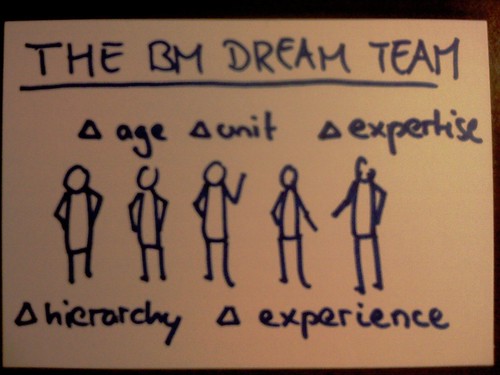
A solution to this is to put a multi-disciplinary business model innovation task force together. One that has the sponsorship of top management and the board. The task force should be composed of people from various levels of hierarchy, from different age groups, with diverse levels of experience, from different business units and with mixed expertise. The diversity will help ideas to emerge, to be discussed, improved and then selected for implementation.


The implementation issue is more challenging. It requires the willingness of top management and the board to experiment and allow for bottom-up ideas to emerge. Unfortunately, it also requires taking some risks to play with new ideas in the field. But if you look at the major record companies today, the risk of inaction is even bigger. I would argue for maintaining a portfolio of business models of which some may even cannibalize the existing main business model.

A great example of a business model portfolio can be found within Nestlé's coffee business. While the Swiss multinational became big in coffee with Nescafé it's current growth engine is now Nespresso. Nespresso sells espresso machines and pods to the high-end of the market. What is impressive is that Nestlé is internally challenging its new multi-billion espresso-pod money-making machine. They expanded their business model portfolio in coffee with Dolce Gusto, a Nescafé sub-brand targeting the lower end of the market. Dolce Gusto's business model is quite similar to that of Nespresso with some tweaks. Nespresso sells to the higher end of the market, while Dolce Gusto sells to the lower end. Nespresso doesn't sell pods through third party retail, while Dolce Gusto does. Though they are both targeting different customer segments, Dolcé Gusto is still cannibalizing Nespresso to a certain extent. Respect for Nestlé that they allow for this internal competition!


Monday, March 16, 2009

The Power of Immersion and Visual Thinking

I am currently keeping my blogposts to a minimum, because I am focusing on book writing and delivering a small number of keynotes and workshops. However, I haven't stopped experimenting. During the last workshop in The Netherlands I changed the structure of the workshop and I had the opportunity to work together with JAM, a Dutch company focusing on visual strategy facilitation. It was a big success.


One of the main changes I made to the workshop structure was a new focus for the break-out sessions. I gave the immersion into client issues much more space. The workshop had two "client immersion sessions" before actually thinking of drafting an innovative business model around the clients. The ultimate task was to re-invent the consulting business model. Instead of getting them to start with business model innovation immediately I made them think about how consulting clients really feel and start innovating from there. This worked out really well, notably because JAM made the outcomes more tangible through images.

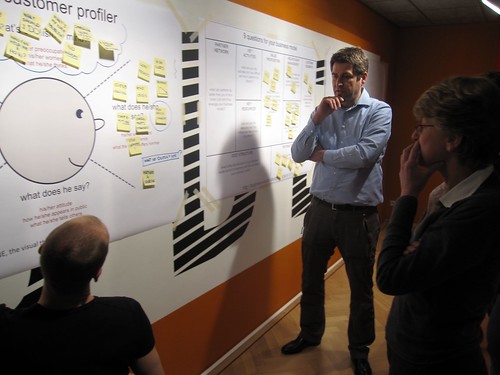
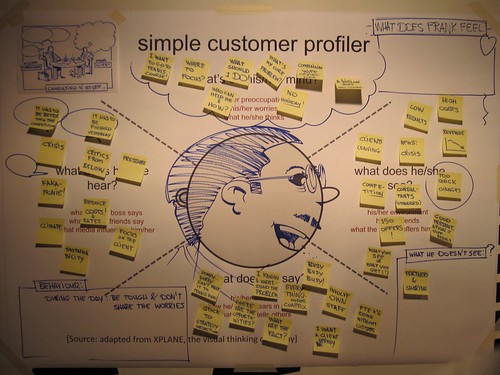
In the first break-out session I asked the groups to make a simple client profile (based on a method from XPLANE, which they call "empathy map"). The goal of this exercise is to think of the client more holistically.


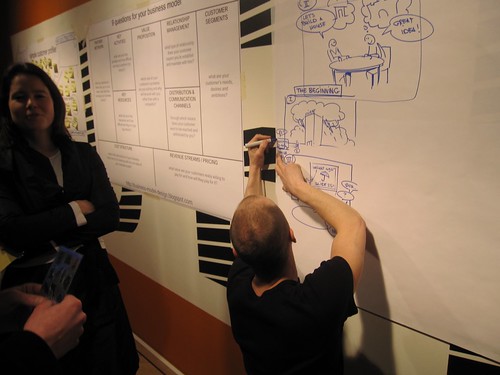
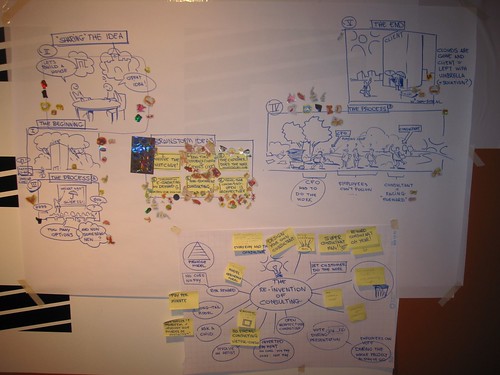
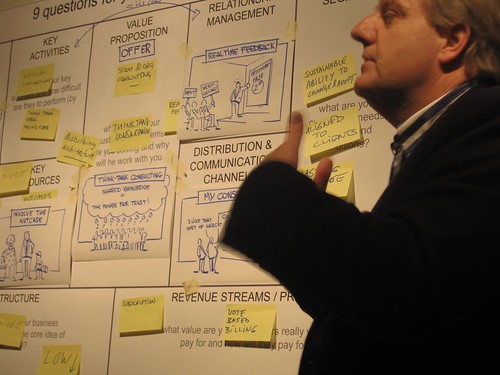
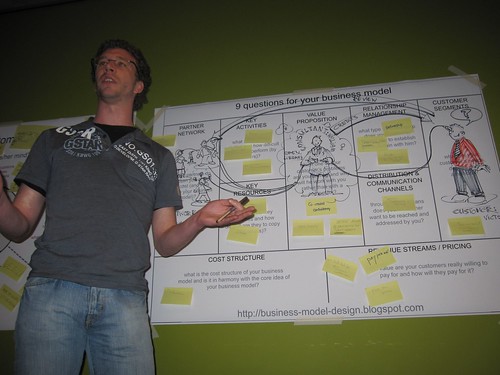
The next break-out session consisted of sketching out the most important client issues. Wouter (1st image below) and Jan (2nd image) from JAM did a wonderful job of making these client issues more tangible through visualizations.


The groups then had a chance to walk around and look at the other groups' work. In addition I asked them to put stickers on the client issues which they found most interesting. This "silent feedback" gave the groups a direction for the following break-out sessions.


After the client immersion sessions I asked the groups to outline the building blocks of their business models with the business model canvas.

At the end of the busy day each group presented their work and we voted for the best new consulting business model.


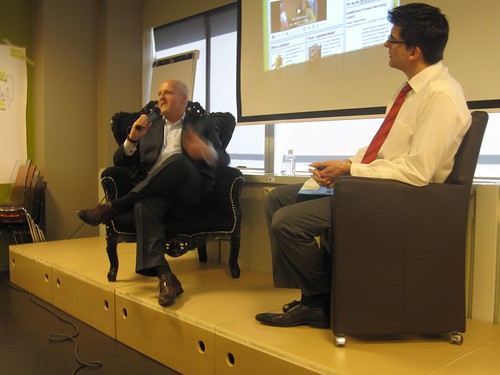
By the way, the workshop was kindly hosted by seats2meet.com, a company led by Ronald van den Hoff. He is disrupting the meeting space and event venue business with an innovative business model. Workshop participants had a chance to learn about his "lessons learned" when I interviewed him on business model innovation issues during the workshop.


All the other photos of the event can be found on my Flickr page. Big thanks to my business partner Patrick van der Pijl who took the pictures, but more importantly, set-up and managed the event.

Friday, February 20, 2009

Publishers, Update your Business Model!

Book publishers, I think your business model is expiring! If you don't update it now, you will suffer the same fate as the music industry: "cluelessness" of what to do to fight steeply declining revenues!

I am by no means an expert of the book publishing industry. My only qualification is being a huge buyer of books and being an aspiring author with a business model innovation book I am working on. The innovation behind the book: I am not alone in writing this book, but my co-author and I are working with another 250+ co-authors who paid to be part of the book writing. Oh, I almost forgot, we not working with a publisher... I never even submitted a manuscript to a publisher...

Here four substantial trends off the top of my head that will rock the book publishing industry and their business models (trends which you probably know, but are not taking seriously):

Distribution is a commodity and attention is scarce

Publishers and retailers used to controlled distribution. That gave them the power to promote authors and their books. With Amazon.com, self-publishing sites such as Lulu.com and the rise of e-books that power is gone because anybody can (print and) distribute a book. The name of the game is now capturing attention in a world of abundance and the absence of distribution scarcity. The publisher’s role of the gatekeeper is soon gone. We are entering the ultimate meritocracy. Books will be successful without a major publisher if they can capture the attention of potential readers through the mastery of the tools of the attention economy: blogs, communities, search engine optimization (SEO) and viral marketing. Readers will catapult a book to success if their attention can be captured. We have already seen this happen sporadically in the music industry.

New business and revenue models will dominate the landscape

Traditional revenue streams from selling books are prone to die. Learn from the music industry: Apple is now the dominant force in digital music and has replaced the incumbent players with a completely different business and revenue model. They sell music online, but they earn most from selling their iPod hardware. Or look towards the artist that give away their music and earn their revenues from increased concert sales or special edition albums. They use “free” as a way to capture attention and earn from new revenue streams.

Authors want to be liberated from the handcuffs of publishers

Very few authors get lucrative royalties or a substantial advance from their publishers. Royalties usually run around 5-10% of the book price. You have to sell VERY many books to live from it decently. In addition publishers don’t allow you to do most of the interesting stuff: experiment with new formats, revenue models and online communities. Hence, new authors have little interest to work with publishers and many of the most lucrative successful authors will run as soon as they have the courage: Paulo Coelho is famous for his stance against the publishing industry and their traditional methods.

New experimental formats will emerge

Books will be written by communities, they will come in versions (like software: cf. the unbook movement by my friend Dave Gray), they will have innovative intellectual copyrights (e.g. creative commons) and novels will have multiple endings. They will take advantage of multimedia by integrating online content and they will be delivered to digital readers like the Kindle. There are absolutely no limits to imagination of how the “books of the future” will look like. Sadly, publishers (with notable exceptions) lack the required imagination to exploit the new opportunity space.

UPDATE
: Richard Baraniuk's talk at TED on textbooks: Goodbye, textbooks; hello, open-source learning:
http://www.ted.com/index.php/talks/richard_baraniuk_on_open_source_learning.html


Wednesday, January 28, 2009

Financial Crisis - an Opportunity for Business Model Innovation?

Innovating during an economic downturn might seem counter intuitive at first sight. However, it is precisely the right moment to do so, as long as you already prepared your company for survival during this extremely severe crisis.

This Monday European and US companies announced a brutal 76'000 job cuts in one single day (cf FT article Gloom deepens as 76,000 jobs go in a day). To focus on business model innovation when you just fired a part of your workforce to bring your company through the crisis might seem very strange. Yet, it is the right moment to do so for a number of reasons.

Business model innovation is difficult to achieve because it affects so many parts of an organization and because it needs the buy-in of so many different people. In addition, it requires the right organizational structures and a sense of urgency to make it happen. All these conditions are, unfortunately, easier to achieve during an economic downturn.

In an economic crisis complacency is gone and everybody feels a sense of urgency to act. People resist change much less when the survival of their company and ultimately their jobs are at stake. We all know how fiercely most people resist change in good times. So when the most urgent issues, such as cash management, are taken care of, a company's management should turn to innovation. This is the best opportunity they will get to position their company for the future of business model innovation.

So what is to be done? A good place to start with is building the right organizational structures that allow for business model innovation. With this I don't simply mean a "traditional" restructuring and shifting of people, but deep structural change. An organization that systematically wants to address business model innovation has the following characteristics:

  • its board explicitly gives the management the mandate to continuously examine business model innovation;

  • it extensively works with multidisciplinary teams across "departments" and across hierarchies;

  • it has mechanisms that allow innovative business model ideas to be evaluated by peers during a first phase, rather than "just by managers";

  • it involves the customer in the process of business model innovation

  • it maintains a portfolio of innovative business models that may even cannibalize the existing business model.

  • it has the right physical space in place to allow multidisciplinary business model project teams to flourish. In other words, it has project/war rooms dedicated to a project during it's entire duration and with lots of whiteboards and walls to post visuals.

Voilà, some "unbaked" thoughts on using the economic downturn as an opportunity to position an organization for the future of business model innovation.

If you have any thoughts to add, please don't hesitate. The forum is yours...

Thursday, January 1, 2009

Wikipedia Needs a Business Model not Donations - plead-for-business model

Wikipedia founder, Jimmy Wales, recently made a plead-for-donations for his extremely successful website (hat tip to Victor Lombardi).

Dear Jimmy Wales, this looks really desperate and I think it's the wrong route you are going down! A great website, such as yours, should not have to rely on the mercy of donors. I would suggest you try to find a better business model, because donations are just not sustainable... Look at the lessons of long standing not-for-profit organizations: They are relying less and less on donations.

With your foundation you are hoping to raise $6 million through your annual campaign. With such a valuable and successful website, I think you would better focus on your core competencies rather than fund raising. You have the assets to build a successful business model and still fulfill your vision. 8 years of track record, 275 million monthly visits to your website, 11 million articles in 265 languages and your 150'000 volunteers merit more than the mercy of donors.

Please learn lessons from companies like Google. Based on advertising they have contributed just as much to trying to make knowledge universally accessible than Wikipedia. Ok, you don't want to use advertising, because your volunteers think that could compromise the content. Well, I think you have a much larger range of possible business models to explore than just one built on advertising based revenue streams. I think you should launch a plead-for-business-models rather than a plead-for-donations.

I don't want to give you any recommendations - you and your board are smart enough. However, if I were to find money to fulfill Wikipedia's vision I would look into other business models that are complementary to your overall not-for-profit goal. Examples:

  • Licensing Wikipedia's technology to for-profit-companies
  • Hosting other Wiki's (similar to what WordPress does for blogs)
  • Membership fees like Amnesty International has
Here Jimmy Wales' plead-for-donations:


Personally, I don't really believe in donations. Some of the organizations that I find most astonishing and have achieved a huge social and economic impact are not at all donation-based (some take donations, but it's not at their core). Here I'm thinking of Grameen Bank, Grameen Phone, Kiva or WISE.

Any other suggestions for Wikipedia business models?

Friday, December 12, 2008

Web-based Business Model Innovation Software and Working on the Wall

Boris Fritscher, a brilliant masters student of HEC business school in Lausanne, Switzerland, has picked up on using software to sketch out business models under the guidance of my co-author, Professor Yves Pigneur.

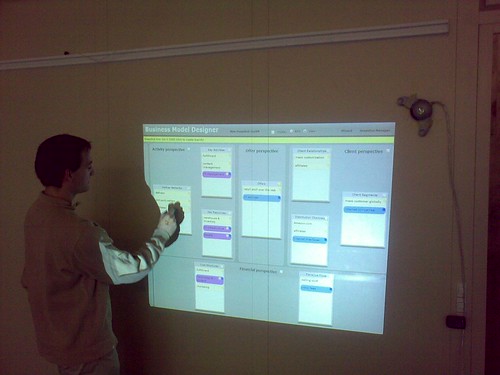
Yesterday he showcased the tool to me and Patrick van der Pijl, producer of my business model book. Boris built a web-based tool that allows the design and description of business models. But Boris didn't keep it there. He extended the tool to allow designing business models live on a projected image on the wall (see picture where Boris works on a business model). How cool is that?


The tool, which is a research project, is still in private beta. We are currently exploring how it can most easily be used to build a database of interesting and innovative business models on the book chunk platform.

I think there is quite some potential in software-based business modeling. Two IBMers, Norbert Herman and Sergey Trikhachev are also working on a tool based on my method. They built a Visio-based tool and are extending it to include business model simulation capacities

Previously I called this Computer Aided Business Model Design (CABMoD), referring to Computer Aided Design (CAD) in Engineering and Architecture. I believe it has similar potential in business...

Monday, December 1, 2008

Business Model Innovation Book - buy early access to raw content now!

In MayEnd of August 2009 Yves Pigneur and I will bring a new management book to the market, which will be a beautiful manual for entrepreneurs and executives about business model innovation.

The interest we are getting for the book is staggering, because our business model innovation methods are already in use in companies such as IBM, Deloitte, Telenor and more. Our aim is to write a book that is visual & simple, applicable, relevant and full of exciting examples.

If you are interested in the topic you now have the exclusive possibility to get early access to the book content and a community of business model innovators. It is a unique opportunity to participate in the makings of a management book that has the potential to become a global bestseller. Working title: "Crafting Innovative Business Models" "Business Model Generation" (ideas welcome).

We will float and discuss the book content as it emerges on www.businessmodelhub.com. Access will only cost you $US 24.- $US 36.- $US 54.- $US 81.- $US 121.50 (the price increased because we exceeded 100 200 300 400 450+ subscribers )


By joining you will have the following privileges:
  • first & exclusive access to raw book content as we write it on www.businessmodelhub.com
  • FREE digital version of the full book when it is published
  • opportunity to influence authors and join content discussions
  • personal mention of your participation (names of participants' in print version in order of sign-up... so you better hurry ;-)
  • about 8 18 installments of book chunks (in a non-linear order as they emerge)
  • 50% discount off the FREE final book
  • access to templates and exclusive PowerPoint slideshows
  • being part of the business model innovation community
When you buy access for $US 121.50 we will invite you to the book chunk platform www.businessmodelhub.com within 48 hours. There you will be able to access everything that is going on. The first "book chunk" is due mid-December and is currently in the making. Already now there is a discussion on the book platform about examples, book format etc. 13 book chunks are online. This is the last opportunity to participate and get your name into the final print version book of this amazing breakthrough project.

Don't miss out on being part of a potential management book bestseller. You will even be able to prove it because your name will be mentioned in the print version!

On Monday January 19. 2009 at 17:00 (CET, Zurich/Geneva) we will hold a free webinar to explain how the book chunk project works.

Thursday, November 20, 2008

Good PowerPoint Design - a strategic business tool

Have you ever "sold" a business project to your management or a venture to a financier? Did you ever happen to use PowerPoint or a similar presentation tool? Probably yes. Well, how much time did you invest in your slide deck? Were your slides beautiful?

Those are questions I now always ask my audiences in my keynotes and workshops on the topic of business model innovation. And most often people do not take PowerPoint seriously. However, they should. PowerPoint is a powerful weapon if used correctly! If used wrongly (as is the case for 90% of presentations) it is rather suicidal.

I attribute a substantial part of my success in my keynote speeches and workshops to my PowerPoint presentations. In fact, the design of my slide decks eat up a big part of my preparation time.

Here my learning as to "Good PPT-Design", which I recently presented at a business incubator in Switzerland