Showing posts with label alexander osterwalder. Show all posts

Monday, June 29, 2009

Beta Version Available! Computer Aided Business Model Design

Together with my former PhD supervisor Professor Yves Pigneur (and now my co-author), I have long advocated the utility of some kind of computer aided business model design tool (see here) – in fact my PhD dissertation aimed at building the foundations for that. Now this vision is starting to become reality. One of Yves’ new PhD students has built such a tool on the basis of Yves’ and my conceptual groundwork.

Boris Fritscher, a brilliant student who has just started working on his PhD, has conceived a Web-based tool to sketch and edit business models. Now this Business Model Editor called BM|DESIGN|ER is open to the public in the form of a beta version (I talked about Boris' work previously here and here). The more you test it and play around with it the better it will get. All you need to give in return is substantive feedback! I hope to see the tool on TechCrunch soon - I think it is a substantial basic tool for start-ups to play around with their business model.

Check it out the BM|DESIGN|ER here:
http://bmdesigner.com/

Personally, I believe we can make a lot of progress in the field of computer supported business design. While I am a great fan of working on whiteboards and/or with post-it™ notes, I also think computer-aided systems have an essential complementary role to play (and one day we will be able to conveniently brainstorm with virtual post-it notes).

Some of the main advantages of computer aided business model design over paper are:

  • Highlighting of linkages between business model building blocks throughout a model – e.g. what resources, activities and partners do we need to serve a specific customer segment.
  • Navigating between layers of a business model – e.g. this allows us to look at the different interlinked parts/layers of Amazon.com’s business model, which has expanded from online retailing towards providing Web infrastructure to other companies.
  • Automatically generating financial spreadsheets based on visually conceived business model prototypes.
  • Advanced manipulation of business models, such as storing, merging, comparing, versioning and sharing models.

Of course this all sounds a bit futuristic and it remains to be seen how business people pick up on this. But look at the history of information systems in business and you might be able to trace a trajectory: We started out with modeling accounting information and now have sophisticated software-based accounting systems. Then we started modeling order and warehouse management. That brought us sophisticated enterprise resource planning systems. We moved on and started modeling and redesigning processes. Now we have quite advanced Business Process Management Systems. So what is the next bastion? Business Models: New ways of creating value ;-)

Boris, bravo for providing a first advance in this direction! Let’s have fun playing around with and advancing the BMeditor!!! Boris put all the examples of our upcoming book, Business Model Generation, into the system. That will give you something to start with…

Saturday, March 28, 2009

There is No Lack of Business Model Innovation Ideas

Currently I am working our upcoming book "Business Model Generation" on a section about ideation: the art of generating innovative business model ideas.

While working on this section I realized that ideas were not necessarily the problem. They exist in abundance within a company or an industry. I've experienced this with multiple organizations. The issue is selecting the right ideas, turning them into something implementable and then actually DOING them.

Regarding the first issue, selection, the biggest problem is that today's organizational and management structures don't allow good business model ideas to become visible. Interesting business model ideas can come from anywhere in a company. Operations, client services, finance... Yet, they have to be selected by management in order to maybe become real options. More often than not they stay invisible. I'm pretty sure that there were many smart folks in record companies that had good busines model innvation ideas. However, the management of these companies preferred to stick to the status quo... and ultimately become disrupted by illegal downloads and challenged by iTunes.

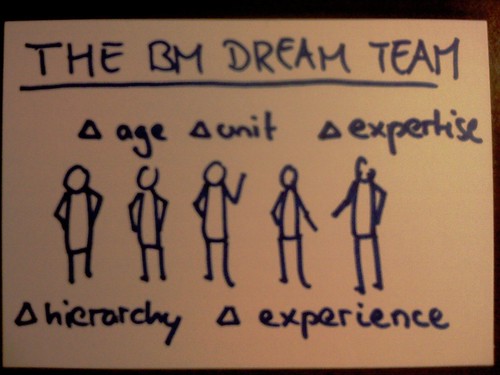
A solution to this is to put a multi-disciplinary business model innovation task force together. One that has the sponsorship of top management and the board. The task force should be composed of people from various levels of hierarchy, from different age groups, with diverse levels of experience, from different business units and with mixed expertise. The diversity will help ideas to emerge, to be discussed, improved and then selected for implementation.


The implementation issue is more challenging. It requires the willingness of top management and the board to experiment and allow for bottom-up ideas to emerge. Unfortunately, it also requires taking some risks to play with new ideas in the field. But if you look at the major record companies today, the risk of inaction is even bigger. I would argue for maintaining a portfolio of business models of which some may even cannibalize the existing main business model.

A great example of a business model portfolio can be found within Nestlé's coffee business. While the Swiss multinational became big in coffee with Nescafé it's current growth engine is now Nespresso. Nespresso sells espresso machines and pods to the high-end of the market. What is impressive is that Nestlé is internally challenging its new multi-billion espresso-pod money-making machine. They expanded their business model portfolio in coffee with Dolce Gusto, a Nescafé sub-brand targeting the lower end of the market. Dolce Gusto's business model is quite similar to that of Nespresso with some tweaks. Nespresso sells to the higher end of the market, while Dolce Gusto sells to the lower end. Nespresso doesn't sell pods through third party retail, while Dolce Gusto does. Though they are both targeting different customer segments, Dolcé Gusto is still cannibalizing Nespresso to a certain extent. Respect for Nestlé that they allow for this internal competition!


Monday, March 16, 2009

The Power of Immersion and Visual Thinking

I am currently keeping my blogposts to a minimum, because I am focusing on book writing and delivering a small number of keynotes and workshops. However, I haven't stopped experimenting. During the last workshop in The Netherlands I changed the structure of the workshop and I had the opportunity to work together with JAM, a Dutch company focusing on visual strategy facilitation. It was a big success.


One of the main changes I made to the workshop structure was a new focus for the break-out sessions. I gave the immersion into client issues much more space. The workshop had two "client immersion sessions" before actually thinking of drafting an innovative business model around the clients. The ultimate task was to re-invent the consulting business model. Instead of getting them to start with business model innovation immediately I made them think about how consulting clients really feel and start innovating from there. This worked out really well, notably because JAM made the outcomes more tangible through images.

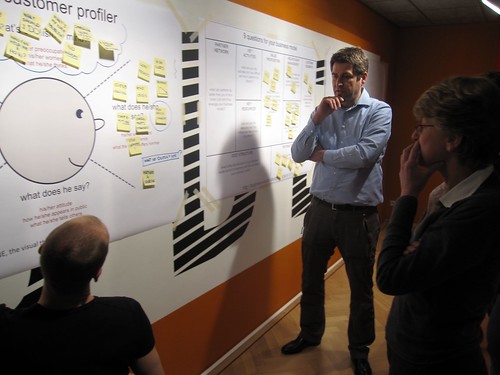
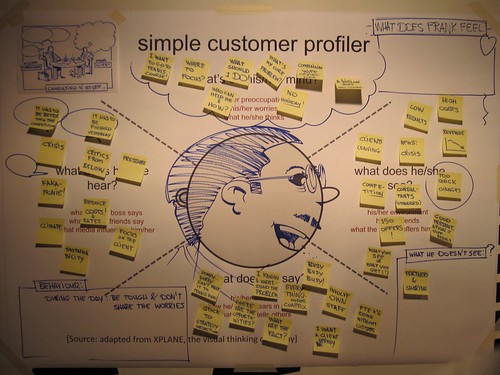
In the first break-out session I asked the groups to make a simple client profile (based on a method from XPLANE, which they call "empathy map"). The goal of this exercise is to think of the client more holistically.


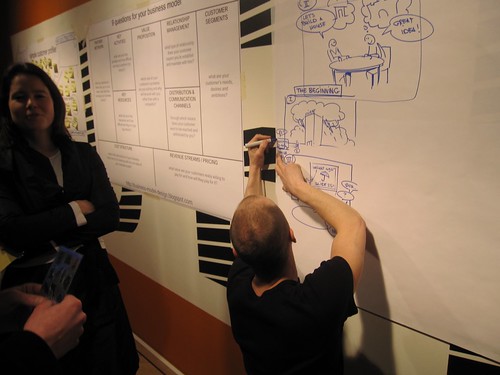
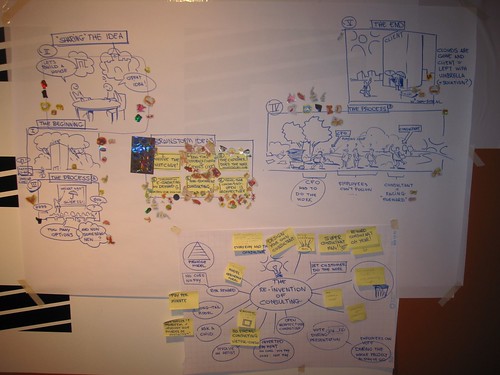
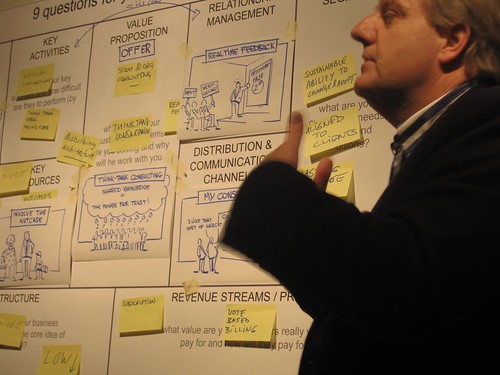
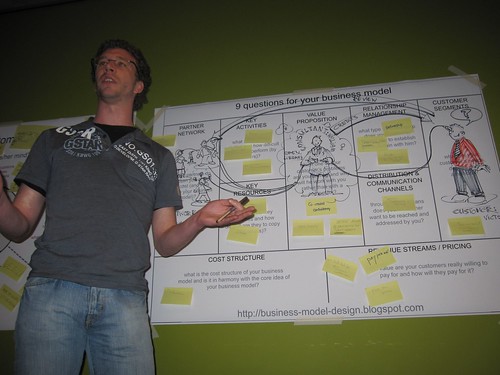
The next break-out session consisted of sketching out the most important client issues. Wouter (1st image below) and Jan (2nd image) from JAM did a wonderful job of making these client issues more tangible through visualizations.


The groups then had a chance to walk around and look at the other groups' work. In addition I asked them to put stickers on the client issues which they found most interesting. This "silent feedback" gave the groups a direction for the following break-out sessions.


After the client immersion sessions I asked the groups to outline the building blocks of their business models with the business model canvas.

At the end of the busy day each group presented their work and we voted for the best new consulting business model.


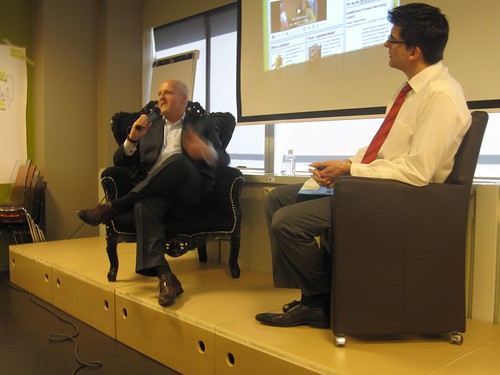
By the way, the workshop was kindly hosted by seats2meet.com, a company led by Ronald van den Hoff. He is disrupting the meeting space and event venue business with an innovative business model. Workshop participants had a chance to learn about his "lessons learned" when I interviewed him on business model innovation issues during the workshop.


All the other photos of the event can be found on my Flickr page. Big thanks to my business partner Patrick van der Pijl who took the pictures, but more importantly, set-up and managed the event.