Currently I am working our upcoming book "Business Model Generation" on a section about ideation: the art of generating innovative business model ideas.
While working on this section I realized that ideas were not necessarily the problem. They exist in abundance within a company or an industry. I've experienced this with multiple organizations. The issue is selecting the right ideas, turning them into something implementable and then actually DOING them.
Regarding the first issue, selection, the biggest problem is that today's organizational and management structures don't allow good business model ideas to become visible. Interesting business model ideas can come from anywhere in a company. Operations, client services, finance... Yet, they have to be selected by management in order to maybe become real options. More often than not they stay invisible. I'm pretty sure that there were many smart folks in record companies that had good busines model innvation ideas. However, the management of these companies preferred to stick to the status quo... and ultimately become disrupted by illegal downloads and challenged by iTunes.
A solution to this is to put a multi-disciplinary business model innovation task force together. One that has the sponsorship of top management and the board. The task force should be composed of people from various levels of hierarchy, from different age groups, with diverse levels of experience, from different business units and with mixed expertise. The diversity will help ideas to emerge, to be discussed, improved and then selected for implementation.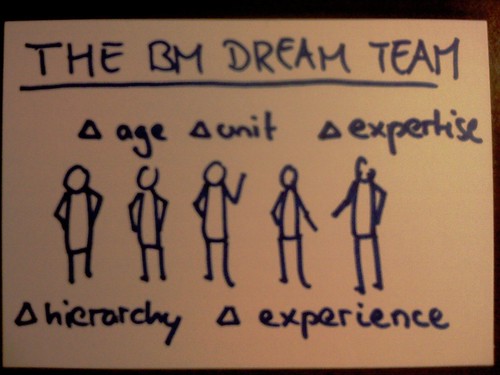
The implementation issue is more challenging. It requires the willingness of top management and the board to experiment and allow for bottom-up ideas to emerge. Unfortunately, it also requires taking some risks to play with new ideas in the field. But if you look at the major record companies today, the risk of inaction is even bigger. I would argue for maintaining a portfolio of business models of which some may even cannibalize the existing main business model.
A great example of a business model portfolio can be found within Nestlé's coffee business. While the Swiss multinational became big in coffee with Nescafé it's current growth engine is now Nespresso. Nespresso sells espresso machines and pods to the high-end of the market. What is impressive is that Nestlé is internally challenging its new multi-billion espresso-pod money-making machine. They expanded their business model portfolio in coffee with Dolce Gusto, a Nescafé sub-brand targeting the lower end of the market. Dolce Gusto's business model is quite similar to that of Nespresso with some tweaks. Nespresso sells to the higher end of the market, while Dolce Gusto sells to the lower end. Nespresso doesn't sell pods through third party retail, while Dolce Gusto does. Though they are both targeting different customer segments, Dolcé Gusto is still cannibalizing Nespresso to a certain extent. Respect for Nestlé that they allow for this internal competition!
Saturday, March 28, 2009
There is No Lack of Business Model Innovation Ideas

Friday, February 20, 2009
Publishers, Update your Business Model!
Book publishers, I think your business model is expiring! If you don't update it now, you will suffer the same fate as the music industry: "cluelessness" of what to do to fight steeply declining revenues!
I am by no means an expert of the book publishing industry. My only qualification is being a huge buyer of books and being an aspiring author with a business model innovation book I am working on. The innovation behind the book: I am not alone in writing this book, but my co-author and I are working with another 250+ co-authors who paid to be part of the book writing. Oh, I almost forgot, we not working with a publisher... I never even submitted a manuscript to a publisher...
Here four substantial trends off the top of my head that will rock the book publishing industry and their business models (trends which you probably know, but are not taking seriously):
Distribution is a commodity and attention is scarce
Publishers and retailers used to controlled distribution. That gave them the power to promote authors and their books. With Amazon.com, self-publishing sites such as Lulu.com and the rise of e-books that power is gone because anybody can (print and) distribute a book. The name of the game is now capturing attention in a world of abundance and the absence of distribution scarcity. The publisher’s role of the gatekeeper is soon gone. We are entering the ultimate meritocracy. Books will be successful without a major publisher if they can capture the attention of potential readers through the mastery of the tools of the attention economy: blogs, communities, search engine optimization (SEO) and viral marketing. Readers will catapult a book to success if their attention can be captured. We have already seen this happen sporadically in the music industry.
New business and revenue models will dominate the landscape
Traditional revenue streams from selling books are prone to die. Learn from the music industry: Apple is now the dominant force in digital music and has replaced the incumbent players with a completely different business and revenue model. They sell music online, but they earn most from selling their iPod hardware. Or look towards the artist that give away their music and earn their revenues from increased concert sales or special edition albums. They use “free” as a way to capture attention and earn from new revenue streams.
Authors want to be liberated from the handcuffs of publishers
Very few authors get lucrative royalties or a substantial advance from their publishers. Royalties usually run around 5-10% of the book price. You have to sell VERY many books to live from it decently. In addition publishers don’t allow you to do most of the interesting stuff: experiment with new formats, revenue models and online communities. Hence, new authors have little interest to work with publishers and many of the most lucrative successful authors will run as soon as they have the courage: Paulo Coelho is famous for his stance against the publishing industry and their traditional methods.
New experimental formats will emerge
Books will be written by communities, they will come in versions (like software: cf. the unbook movement by my friend Dave Gray), they will have innovative intellectual copyrights (e.g. creative commons) and novels will have multiple endings. They will take advantage of multimedia by integrating online content and they will be delivered to digital readers like the Kindle. There are absolutely no limits to imagination of how the “books of the future” will look like. Sadly, publishers (with notable exceptions) lack the required imagination to exploit the new opportunity space.
UPDATE: Richard Baraniuk's talk at TED on textbooks: Goodbye, textbooks; hello, open-source learning:
http://www.ted.com/index.php/talks/richard_baraniuk_on_open_source_learning.html
Friday, December 19, 2008
Apple iPod - Business Model Example Series: Issue 2
This week I was in Madrid to work together with XPLANE, the leading company when it comes to visual thinking in strategy & business. XPLANE will help me with the visuals for some examples and processes in my upcoming book on business model innovation.
Together with Pablo Ramirez of XPLANE we worked on several things, including the business model of the Apple iPod. Here is a first sketch - open for your input & feedback...
Don't hesitate with comments & feedback. This is most certainly one of the examples we will use in the book. At every workshop & event I do, the Apple iPod comes up because of its influence on the music industry.
